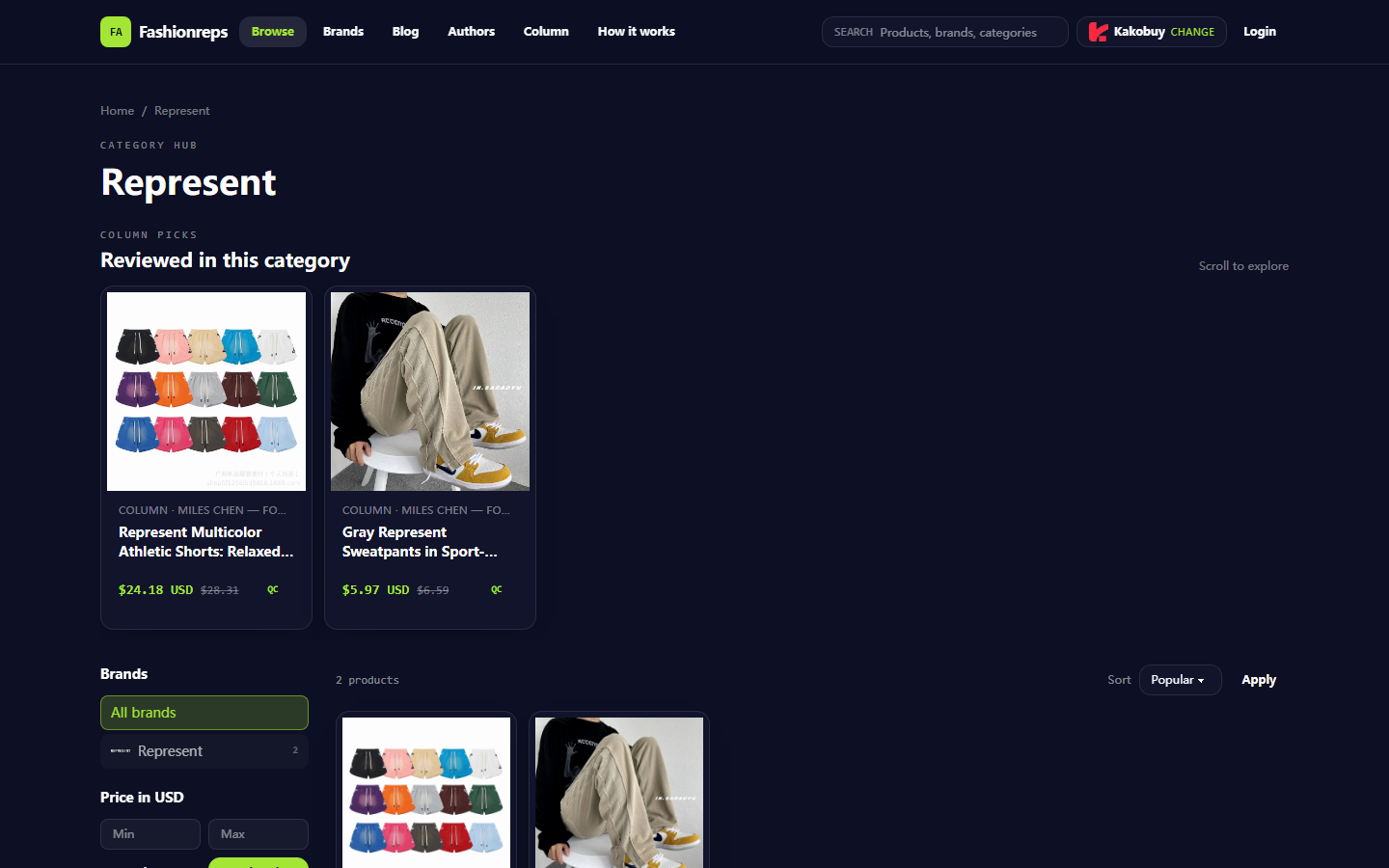
 Caption: Example of a Represent category page on [fashionreps](https://fashion-reps.net/), suitable for confirming visible product information, reference prices, and purchase links. ## Reader Task and Review Scope This article addresses a specific problem: when you see [Represent pants](https://fashion-reps.net/pants/represent), sweatpants, or casual pa

Caption: Example of a Represent category page on fashionreps, suitable for confirming visible product information, reference prices, and purchase links.
Reader Task and Review Scope
This article addresses a specific problem: when you see Represent pants, sweatpants, or casual pants on fashionreps, you want to determine if they are suitable for long sitting commutes, daily walking, and consolidated shipping, rather than just ordering based on brand name, low price, or a thumbnail image.
This article is for three types of buyers:
- Those who already have a well-fitting pair of pants and can measure waist, hip, thigh, front rise, and inseam.
- Those who plan to order through a shopping agent and are willing to check photos and sizes during warehouse QC.
- Those who care more about commute comfort, waist pressure when sitting, pant length, and return risks, rather than just the overall look. 🙂
This article is not for scenarios where you want to confirm authenticity, official fabric composition, long-term durability conclusions, or real-person wearing experience. The fashionreps page can help you discover products and proceed to the agent purchase process, but ordering, payment, warehouse inspection, international shipping, and after-sales typically need to be completed on the shopping agent's website. This article only makes pre-purchase judgments based on visible page information, product category clues, and actionable verification methods.
Verification date: 2026-10-08. Visible page information may change with inventory, price, agent entry, and seller page updates, so you need to reopen the product page and agent page to confirm before ordering.
How to Verify represent Pants Information on fashionreps
When looking at Represent pants on fashionreps, the first step is not to ask "Is it worth it?" but to confirm what verifiable information the page actually gives you. The currently visible Represent category page shows Represent-related items and has had gray sweatpants entries; the same category page may also mix in shorts or other clothing. Therefore, before entering a specific product, you need to separate "the category page shows the brand" from "the specific product is suitable for you."
It is recommended to verify in this order:
- First confirm whether the product title clearly indicates pants, such as sweatpants, pants, trousers, joggers, or similar descriptions.
- Then check whether the product page has clear images, size options, reference price, purchase button, and agent jump link.
- After entering the agent page, re-check the seller title, color, size, price, domestic shipping, and return/exchange instructions.
- After ordering to the warehouse, wait for QC photos to check the waist, length, hem, stitching, fabric texture, and size label against the page description.
If the category page only has a vague title, or the seller page after jumping lacks a size chart, color options, actual photos, and return/exchange instructions, such products are not suitable for direct ordering. For pants, the loss from wrong sizing is usually more significant than for T-shirts, because if any of the waist, front rise, or length is not right, the commute experience will be affected.
Visible Risks of Waist, Front Rise, and Length
Represent-style casual pants, sweatpants, or loose pants most often have problems not in "does it look like the picture?" but in waist pressure when sitting, front rise allowance, and length bunching.
For the waist, look at three points: whether there is a drawstring, whether there is an elastic structure, and whether the size chart distinguishes between flat waist measurement and stretched waist measurement. If there is only a vague S/M/L/XL option, it is not recommended to buy your usual size directly. During long sitting commutes, if the waist is only suitable when standing, it may press on the abdomen when sitting; if it is too loose, it will slide down when walking or going up and down stairs.
The front rise determines whether it presses when sitting. Page images usually cannot directly prove front rise comfort; you can only look at fit clues: whether the distance from waistband to crotch is significantly short, whether the model or flat lay photo shows a tight crotch, and whether the product is slim fit. When there is no front rise data, buyers should use old pants as a benchmark instead of just relying on height and weight recommendations.
For length, you need to look at both total length and hem structure. Straight-leg pants that are too long will bunch at the shoe; tapered pants that are too long will wrinkle at the calf; loose sweatpants with heavier fabric will show more obvious bunching at the hem. For commuters, pants that are slightly shorter are usually easier to deal with than clearly dragging on the floor.
| Check Point | What to Look for Before Ordering | What to Confirm Again During QC |
|---|---|---|
| Waist | Elastic, drawstring, waist range | Flat waist width, drawstring holes, whether waist is crooked |
| Front rise | Whether size chart gives front rise | Front flat lay proportion, whether crotch stitching is tight |
| Length | Total length, inseam, or model reference | Tape measure actual measurement, whether hems are uneven |
| Hem | Straight, tapered, opening width | Hem width, ribbed elasticity, loose threads |
How Straight, Loose, or Tapered Fits Affect Commuting
Commuting scenarios have different standards from photo scenarios. When taking photos, pants only need to look good in silhouette to pass; but commuting involves sitting in vehicles, walking, going up and down stairs, long sitting in the office, and possibly wet roads. 😅
Straight-leg fit has the advantage of stable coordination; the legs don't cling easily, suitable for those who want clean lines. The risk is that once the length is too long, shoe accumulation will be obvious, especially with heavier fabric.
Loose fit is more suitable for those pursuing a streetwear look and extra room. Its risks lie in volume, weight, and visual proportion: when consolidated shipping, heavy pants may increase package volume; when wearing, if the waist is not stable enough, the pants will look sloppy.
Tapered pants or sweatpants are usually more suitable for daily walking and light sporty coordination. Their risk is in the calf and ankle area; if the ribbing is too tight, it will bind; if too loose, it loses the tapered effect. For long sitting commutes, tapered pants also need special attention to whether the knee area easily bags out, but this usually cannot be concluded directly from the product page and can only be observed after receiving.
What Fabric Descriptions and Image Clues Can Tell You
Fabric descriptions can provide direction but cannot replace physical judgment. If the product page only says cotton, polyester, fleece, terry, or blended fabric, it at most indicates the general type, not softness, weight, breathability, or abrasion resistance.
You can look for these clues from images:
- Surface texture: smooth tends to be more sporty casual; looped or fleecy tends to be thicker, more suitable for cold weather.
- Drape: whether the pants legs hang naturally when laid flat helps judge stiffness or softness tendency.
- Knee and hip areas: if the sample image already has obvious wrinkles, it may leave creases more easily after long sitting.
- Stitching density: the clearer the stitching at the waist, pockets, hem, and crotch, the easier it is to compare during QC.
But there are several things that cannot be extrapolated from the page: you cannot say it will definitely be comfortable, will not pill, will suit all seasons, or judge thickness from thumbnails. A safer approach is to treat page descriptions as "clues to be verified" and QC photos and in-hand inspection as the final basis.
How to Consider Size Chart, QC, and Return/Exchange Terms Together
The most worthwhile thing to do for Represent pants is the "old pants comparison method." Find a pair of pants you already wear comfortably, lay them flat and measure waist width, hip, thigh, front rise, length, and hem width, then compare with the product size chart. Do not rely solely on height and weight recommendations, because two people of the same 175 cm may have completely different waist-hip ratios and length preferences. 📏
It is recommended to allow for a 2-3 cm margin of error. In cross-border purchases, size charts, manual measurements, and QC tape measure angles can all produce errors. If the product page has no size chart, or the agent page cannot confirm returns/exchanges, it is not recommended to buy for essential commuting needs.
During QC, focus on:
- Whether complete front and back photos are taken.
- Whether size label, color, and hem structure are visible.
- Whether tape measure photos are provided for waist width, length, or key positions.
- Whether there are obvious stains, holes, crooked stitching, missing drawstrings, or uneven pant legs.
- Whether the return/exchange window is still valid and whether you need to bear domestic return shipping costs.
If QC photos only show partial areas, request additional photos from the agent. Pants are not just about the logo; waist and length matter more for daily use than minor details.
Comfort and Durability That Cannot Be Extrapolated from the Page
These pages can help you pre-screen purchases but cannot complete a real wearing test for you. The following conclusions should not be stated definitively without in-hand evidence:
- "Definitely comfortable for long sitting."
- "Fabric is thick" or "definitely breathable in summer."
- "No pilling, no deformation, no shrinkage."
- "Fit suits all body types."
- "Completely identical to official products."
A more actionable judgment is to stratify risks: the page can confirm title, images, price reference, category, and some purchase entry; the agent page can confirm current available options, domestic shipping, return/exchange terms, and warehouse services; QC can confirm whether the item sent to the warehouse has obvious appearance and size issues; true comfort and durability can only be judged through wearing records after receipt.
For commuters, the highest priority is to eliminate high-probability misfits rather than pursue perfect descriptions on the page. In other words, avoid obvious mistakes first, then consider style bonuses. ✅
Final Action: Decide with Your Personal Old Pants Data
Before ordering, write down your old pants data, then follow this decision process:
- If the product has no clear size chart, do not buy.
- If waist, front rise, or length differs too much from old pants, do not buy unless you explicitly want to change the fit.
- If page images cannot clearly show hem, waist, and crotch structure, wait for agent page or QC supplementary photos before deciding.
- If return/exchange terms are unclear, do not treat it as an essential commuting pants purchase.
- If QC actual measurements differ significantly from the size chart, handle it within the return window as a priority.
Regarding cost savings, using fashionreps to discover products and purchasing through an agent may help you compare different shopping agent entries and reference prices, but the final total cost also includes domestic shipping, agent service fees, international shipping, volumetric weight, taxes, and possible return costs. Looking only at the product price will underestimate actual expenses.
Increased risks mainly come from size errors, page information changes, insufficient QC, missed return windows, international shipping time, and customs requirements. Pants are also more likely than small accessories to end up "not broken but don't want to wear" due to length, waist, and fit issues.
Suitable for this approach are those willing to measure old pants, wait for QC, accept cross-border shopping uncertainty, and treat these pants as a filterable item rather than a guaranteed successful purchase. 🧾
Situations where this approach is not recommended are also clear: you need them urgently, cannot accept return communication, have no well-fitting old pants for comparison, need confirmed material and durability, or your destination country has import restrictions on such goods that you cannot confirm. In these cases, pausing is more cost-effective and less stressful than dealing with a wrong purchase.