## What Decision This Guide Solves for Filtering Omega Watch Candidates If you're comparing Omega watch candidates on [fashionreps](https://fashion-reps.net/), the real problem isn't "which one looks best"—it's how to turn product cards, images, model clues, dial, and strap information from the site into a reviewable shortlist before you decide to keep, verify further, or pause. This guide is for buyers who have already found several Omega watch candidates and want to reduce repeated page visits
What Decision This Guide Solves for Filtering Omega Watch Candidates
If you're comparing Omega watch candidates on fashionreps, the real problem isn't "which one looks best"—it's how to turn product cards, images, model clues, dial, and strap information from the site into a reviewable shortlist before you decide to keep, verify further, or pause.
This guide is for buyers who have already found several Omega watch candidates and want to reduce repeated page visits and lower the risk of picking the wrong one. After reading, you should be able to do three things: create a separate record for each candidate, distinguish between site-visible information and your own inferences, and stop judgment when specs, images, and links are inconsistent. It's not for authenticating watches, guaranteeing quality, or replacing confirmation of stock, price, payment, or after-sales on the shopping agent site.
As of October 10, 2026, this article only works with the fashion-reps catalog's visible navigation, brand pages, product cards, and QC image entries. Prices, stock, shipping, taxes, and agent policies should still be double-checked on relevant pages before placing an order. ⌚️

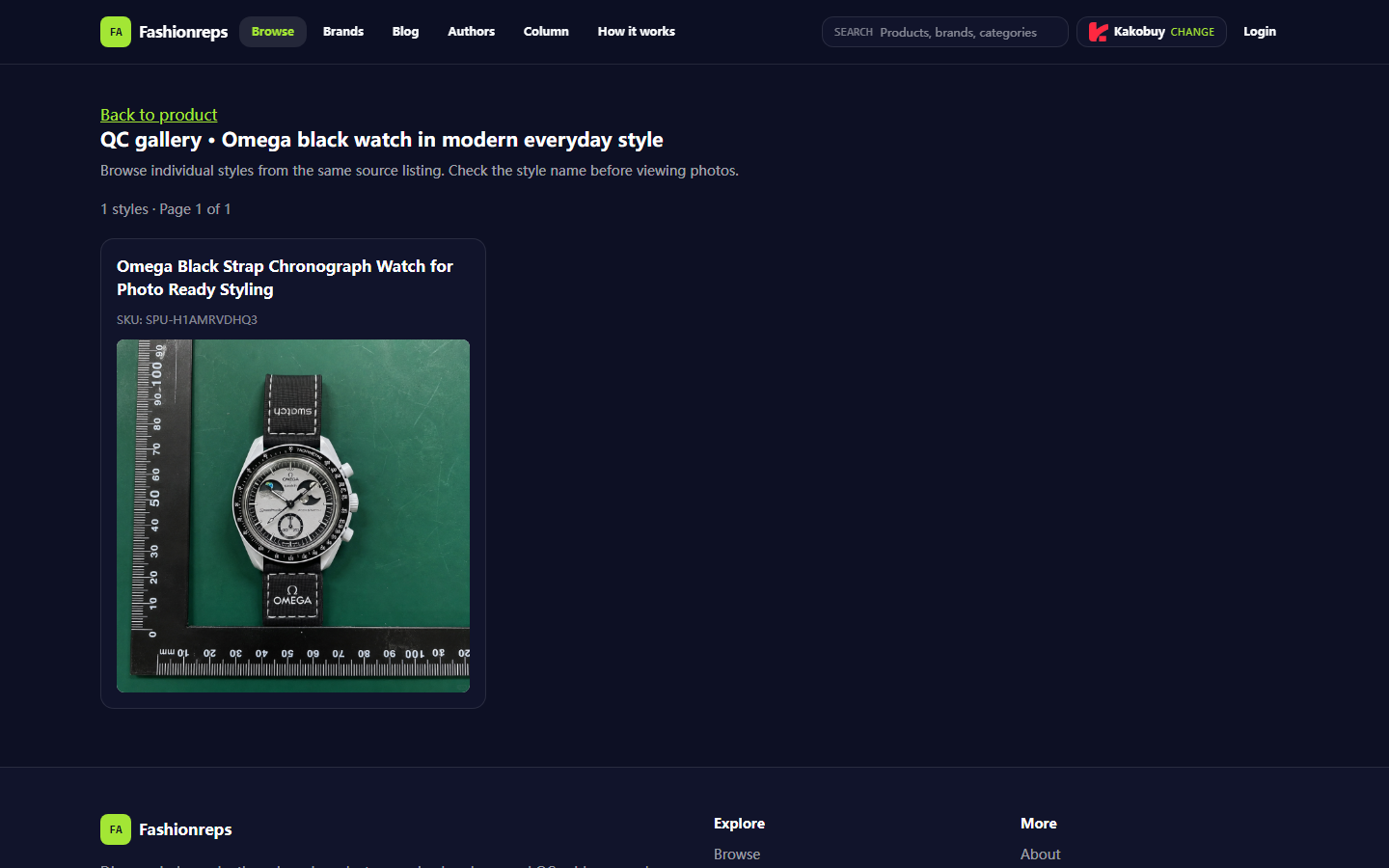
Image: Website catalog and spec-checking approach for organizing Omega watch candidates.
Navigating Brand Pages and Product Cards from the fashionreps Spreadsheet
First, think of fashionreps' spreadsheet as a "browsable product catalog" rather than a ready-made personal shopping list. The site lets you discover candidates by brand, category, or search; you need to separately record the information suitable for comparison.
When entering candidates, follow this order:
- Go to the Omega-related page from the brand or product catalog.
- Open the product card and first record the visible product name and SKU or other identifier.
- Check whether the product images, options, and source links belong to the same product record.
- Only after recording, add the candidate to Google Sheets.
- For items needing further inspection, keep the original page entry, not just saved images or copied names.
fashion-reps pages provide product discovery and links to external shopping agents. The Buy button on the page will take you to the corresponding agent site based on your selected agent; orders, payments, and shipping are handled by the agent site. Therefore, the catalog's product info is not directly equal to the agent's current stock or final transaction terms.
When viewing a product page, ask yourself three questions first:
- Is the product name distinct enough to tell this model from other Omega candidates?
- Do the images, specs, and options belong to the same product card?
- Does the current link still open and show clear product content?
If the page redirects, shows empty content, has only tags without product info, or the link's source is unverifiable, don't treat it as a valid candidate for further comparison.
How to Set Up Model Clue, Dial, Strap, and Source Columns in Google Sheets
Google Sheets' role is not to replace website browsing but to turn scattered observations into a filterable, collaborative, traceable record. Use one row per candidate and avoid merging multiple products into one cell.
At minimum, create these columns:
| Field | Record Content | Purpose |
|---|---|---|
| Candidate ID | Custom ID, e.g., OMEGA-001 | Avoid identifying by name only |
| Page Product Name | Copy the site's visible name exactly | Preserve page evidence |
| SKU or Page ID | SKU or other identifier shown on page | Distinguish similar items |
| Model Clue | Clues visible in page text or images | Mark info pending verification |
| Dial | Visible descriptions: color, markers, hands, etc. | Compare appearance differences |
| Strap | Visible descriptions: black, metal, leather, etc. | Avoid wrong configuration |
| Image Status | Viewed, partially viewed, or cannot view | Assess evidence completeness |
| Source Page | Keep the original product page entry | For easy backtracking |
| Record Date | e.g., 2026-10-10 | Identify timeliness |
| Verification Status | Keep, verify, pause | Support next-step decisions |
Be cautious with model clues. Letters or numbers appearing in the page name or images are not necessarily official model numbers; unless supported by a verifiable original source, write them as "page-displayed clue" or "model to confirm," not as confirmed model numbers.
Dial and strap should also be recorded as visible information. For example, "black dial" and "black strap" are page-level descriptions; "certain material" or "a series' official configuration" need extra sources. Don't turn your own identification into site-confirmed specs just because the appearance looks similar. 🔎
How Site Search and Sheet Filtering Work Together to Narrow Candidates
The site is for discovery and viewing; Google Sheets is for organizing and excluding. When combining them, don't start with too many keywords; instead, build a small, explainable filtering process.
First round: keep only candidates that are clearly Omega watches, have fairly complete page info, and links that still work. Second round: filter by your actual needs, e.g.:
- Dial color matches your target look.
- Strap type fits wearing or matching needs.
- Images clear enough to see main appearance features.
- Page provides a clear product name or identifier.
- Are there duplicate pages, duplicate SKUs, or different image entries from the same source?
Use simple status values in the sheet:
- Keep: Page, images, and main spec clues are consistent.
- Verify: There's a usable candidate, but model, options, or source is incomplete.
- Pause: Obvious contradictions, dead page, or insufficient evidence.
- Duplicate: Points to the same product or source as another row.
Filtering conditions should serve your purchase decision, not create more tags. If you just want a black dial, filter by dial column first, then go back to the site to open pages one by one to confirm; don't judge the entire product record meets conditions based solely on search result words.
How to Record and Cross-Check Images, Specs, Options, and Links Separately
Images are appearance evidence, specs are text or page field evidence, options are configuration evidence that may affect what you order, and links are backtracking entries. These four types should be recorded separately; don't assume other fields match just because images look consistent.
For each candidate, do a four-way cross-check:
- Do the dial and strap in images match the product name or option description?
- Can the model clue in the product name be found elsewhere on the page?
- Do option changes cause changes in images, specs, or SKU?
- Does the source saved in Google Sheets still lead back to the original product card?
If a product has multiple styles or options, split into multiple rows or add an "Option Value" column to avoid merging different configurations into one vague candidate. The Omega black strap chronograph example in context shows that QC pages may display items as separate styles with SKUs; this info can be used for records, but you cannot infer material, movement, functional reliability, or authenticity not explicitly stated on the page.
Judgment on images also has boundaries. Images help you record color, layout, strap shape, and visible differences; they cannot prove feel, durability, water resistance, accuracy, or authenticity. If images are blurry, lack angles, or conflict with text, change status to "verify" or "pause".
Boundaries for Viewing Product Images on Phone vs. Organizing Fields on Computer
Phone is good for quickly viewing images, opening product cards, and marking candidates for later review; computer is better for maintaining column structure, batch filtering, adding sources, and checking duplicates. Dividing tasks between devices reduces missed fields on small screens and prevents decisions based only on screenshots. 📱💻
On phone, you can:
- View main product images and QC image entries.
- Quickly mark candidates that clearly don't meet needs.
- Copy or save product page entries for later organization.
- Check if pages still open properly.
On computer, you can:
- Uniformly fill model clue, dial, strap, and source columns.
- Filter by verification status, dial, or strap.
- Find duplicate SKUs, names, and sources.
- Compare sheet records with product pages side by side.
- Share the same candidate list with collaborators and keep update times.
Don't treat phone screenshots as complete records. Screenshots may miss page title, source, options, and date, and later it's hard to confirm which row it corresponds to. If you must save screenshots, record the candidate ID and source page at the same time, and cover personal data like order numbers, addresses, phone numbers, and payment info.
Evidence Boundaries: Site-Visible Info, Sheet Records, and Authenticity Judgment
The purpose of a candidate sheet is to help you filter and verify, not to authenticate for you. Site-visible info supports "what the page shows" judgments, not automatically "what the product really is" judgments.
Page facts you can record include: product name, SKU, visible color descriptions, strap descriptions, observable appearance in images, and page entries. Content requiring external sources or seller confirmation includes: official model, material, movement, size accuracy, water resistance, stock, price, after-sales promises, and authenticity.
When assessing product quality, break down the questions:
- Information quality: Are name, images, options, and links consistent?
- Page quality: Is it accessible with clear product content?
- Image evidence: Are they clear and cover the appearance areas you care about?
- Transaction terms: Are price, stock, shipping, tax, and after-sales clearly stated by the agent?
- Authenticity: Is there enough independent evidence? Don't conclude based on page appearance alone.
If a page has only pretty images but insufficient specs or source info, the most reasonable status is not "high quality" but "insufficient evidence". Similarly, complete page info does not equal confirmed authenticity. Recording this way prevents mixing visual impressions, product descriptions, and transaction promises. ⚠️
When to Keep a Candidate and When to Pause Due to Inconsistent Information
Conditions for keeping a candidate: page is accessible, product name or identifier is clear, images have no obvious conflicts with main visible descriptions, source can be traced back, and you've marked unconfirmed facts in the sheet.
Situations to pause a candidate:
- Product name points to one configuration, but images show another.
- Source link in sheet opens to a blank page, tag page, or different product.
- Same SKU corresponds to clearly different names, images, or options.
- Page only has images, cannot confirm product identity.
- Key fields you need lack any verifiable source.
- Price, stock, or agent terms are from old records and current page cannot confirm.
Pausing doesn't mean the product is necessarily problematic; it means current evidence is insufficient for the next step. You can go back to the page to re-verify, ask the shopping agent about current terms, or find independent original spec sources. Don't force-keep candidates with inconsistent data just because you've already spent time organizing.
Final Action: Candidate Verification Checklist Before Buying Omega Watch
Before ordering, do a quick check on each final candidate:
- Record page product name, SKU, or other visible identifier.
- Fill model clue, dial, strap, and options separately; don't write inferences as confirmed facts.
- Save a traceable product source and record the verification date.
- Compare images and text, marking consistent, verify, or conflict spots.
- Set final status in Google Sheets: keep, verify, or pause.
- Open the shopping agent site and re-verify price, stock, payment, shipping, tax, and after-sales terms.
- For content you cannot verify as authentic, quality, or performance, keep doubts; don't replace evidence with conclusions like "genuine", "guaranteed", or "absolutely reliable".
What you want in the end is not a full-looking sheet, but a candidate list that answers "why keep this one, what evidence is missing, who to ask next". fashion-reps helps you discover and browse products; Google Sheets turns observations into filterable records; together they suit spec-checking of Omega watch candidates.
Fashionreps Agent Platform Shopping FAQ
1. What process does litbuy-ai.com recommend to evaluate whether a product meets quality standards?
Use the quality-check photographs rather than depending only on factory images, because factory shots are often edited. Inspect the QC images to verify that the item satisfies your particular detail requirements before you commit to buying it. Additionally, take note that goods with extremely low prices are usually not high quality, so it is wise to stay away from such offers.