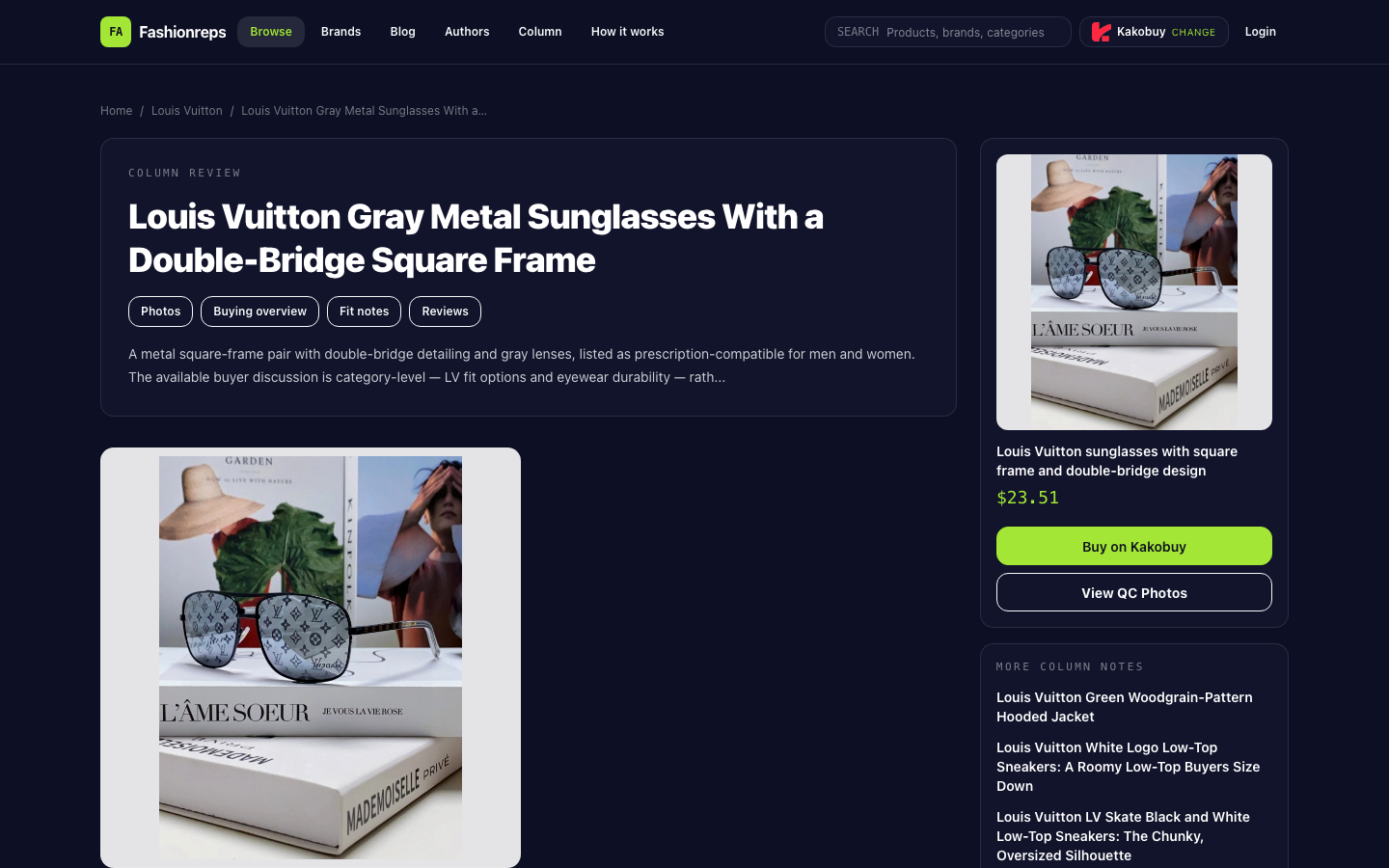
Bottom Line First This Louis Vuitton square bridge sunglasses product page states that it supports prescription lenses and is suitable for both men and women; however, the page does not provide lens width, bridge width, temple length, or whether it uses the E or W fit. Therefore, it can be considered as a candidate for prescription lens frames, but you cannot confirm that it suits your face shape, pupillary distance, or lens processing needs based solely on appearance or the "prescription len
Bottom Line First
This Louis Vuitton square bridge sunglasses product page states that it supports prescription lenses and is suitable for both men and women; however, the page does not provide lens width, bridge width, temple length, or whether it uses the E or W fit. Therefore, it can be considered as a candidate for prescription lens frames, but you cannot confirm that it suits your face shape, pupillary distance, or lens processing needs based solely on appearance or the "prescription lens compatible" description.
If you only plan to wear it as regular decorative sunglasses, the main risk is uncertainty about the fit and wearing stability; if you plan to replace the original lenses with prescription lenses, you should first obtain the dimensions, fit type, and frame structure information before deciding whether to order.

What the Page Has Clarified
The page describes the product as a metal square frame, double bridge design, and gray lenses. The page copy states that it can be fitted with prescription lenses and is labeled as unisex. This information only describes the appearance and product page positioning; it does not directly prove that the frame is suitable for a specific prescription, nor does it replace confirmation from the seller regarding lens thickness, installation method, or processing limitations.
The page also mentions that a Louis Vuitton sunglasses model guide states that current Louis Vuitton sunglass lenses have UV protection. However, this is information from a brand model guide and cannot be used to infer that the replaced prescription lenses will have the same protective specifications. If you need UV or other lens functions, you should confirm the specific parameters with the lens processor.
The Key to Prescription Lens Compatibility Is Not Appearance but Dimensions
The page does not provide the following four basic dimensions:
- Lens width
- Bridge width
- Temple length
- Whether the frame uses the E or W fit
Among these, the wearing position of the E and W fits may differ significantly. The page notes that Louis Vuitton eyewear typically has E and W fits, and the two fits sit differently on the face; existing buyer discussions also suggest that without trying on or further confirmation, it is hard to judge whether a fit is suitable based only on labels.
For prescription lenses, incomplete dimensions affect at least three judgments: whether the lens optical center aligns with the pupillary distance, whether the lens edges require significant processing, and whether the frame stays stable on the nose bridge and ears. Existing information does not provide the dimensions of this specific frame, so it cannot determine whether it suits a particular prescription.
Judging Whether to Proceed Based on Three Needs
| Usage Need | What Current Information Supports | Information to Obtain Before Ordering |
|---|---|---|
| Regular decorative wear | Appearance positioning fairly clear; page describes metal square frame, double bridge, gray lenses | E/W fit, lens width, bridge width, temple length |
| Needing to replace with prescription lenses | Page claims prescription lens compatibility, but cannot confirm specific prescription or processing outcome | Four dimensions, lens specifications, frame structure, acceptable lens range for processor |
| Concerned about frame stability | Existing discussions mention some eyewear materials and lens/shape combinations may be difficult to adjust, and some styles have quality control concerns like melting or breaking; these are category-level discussions, not test conclusions for this style | QC photos for this style, photos of hinges and frame joints, seller confirmation of materials and structure |
Order of Information to Request from Seller
First, ask about the fit type. Directly ask whether this frame is E or W fit. If the seller cannot confirm, at least request front-facing wearing photos or flat lay photos with a ruler, but these can only help estimate and cannot replace formal dimensions.
Second, request the four dimensions: lens width, bridge width, temple length, and overall frame width if necessary. If the seller only replies "one size" or "unisex," that still does not complete the dimension confirmation.
Third, confirm the lens information. Ask about the specific specifications of the current gray lenses, whether they are original or replacement lenses, and who will process the prescription lenses. The page only states prescription lens compatibility but does not provide acceptable prescription range, refractive index, lens thickness, or installation method.
Fourth, review QC photos of the corresponding style. Focus on the lens edges, frame corners, double bridge connections, nose pad or bridge contact areas, hinges, and temple joints. Do not use photos of other styles, colors, or generic display images as quality evidence for this style.
When to Proceed and When to Pause
If the seller can provide the E/W fit, four dimensions, lens specifications, and QC photos for this style, you can give these materials to an optometrist or optician to judge whether the frame suits your pupillary distance and prescription. In this case, the page's "prescription lens compatible" description only serves as a preliminary screening condition.
If only "supports prescription lenses" is confirmed without dimensions and fit, it is advisable to pause. Because you still cannot judge the lens optical center position, nose bridge fit, and temple length; purchasing and then processing may lead to higher costs for returns or re-fitting.
If the seller cannot provide dimensions or QC photos for this style, especially if you cannot try on and are concerned about frame stability, it is not recommended to treat this frame as a low-risk prescription lens option. Existing category discussions have raised concerns about some materials, lens shape combinations, and quality control, but there is insufficient evidence to attribute these issues to this style, so you need to rely on actual photos of this style rather than generalized judgments.
Final Decision Criteria
Dimensions confirmed: Give the four dimensions and prescription data to a professional optician, confirm pupillary distance, lens thickness, and processing method before deciding.
Need additional evidence: First request from the seller the E/W fit, lens width, bridge width, temple length, lens specifications, frame structure explanation, and corresponding QC photos.
Cannot try on and information incomplete: Treat it as a high-uncertainty choice; do not make a purchase decision based solely on the square frame appearance, brand name, or the "prescription lens compatible" statement on the page.
The most clear value of these sunglasses currently is the appearance direction of square frame, double bridge, and gray lenses, as well as the page's description of prescription lens compatibility; the biggest gaps are the dimensions, fit type, and structural evidence for this style. For prescription lens needs, filling in these gaps first is more effective in reducing fitting risk than continuing to compare appearances.