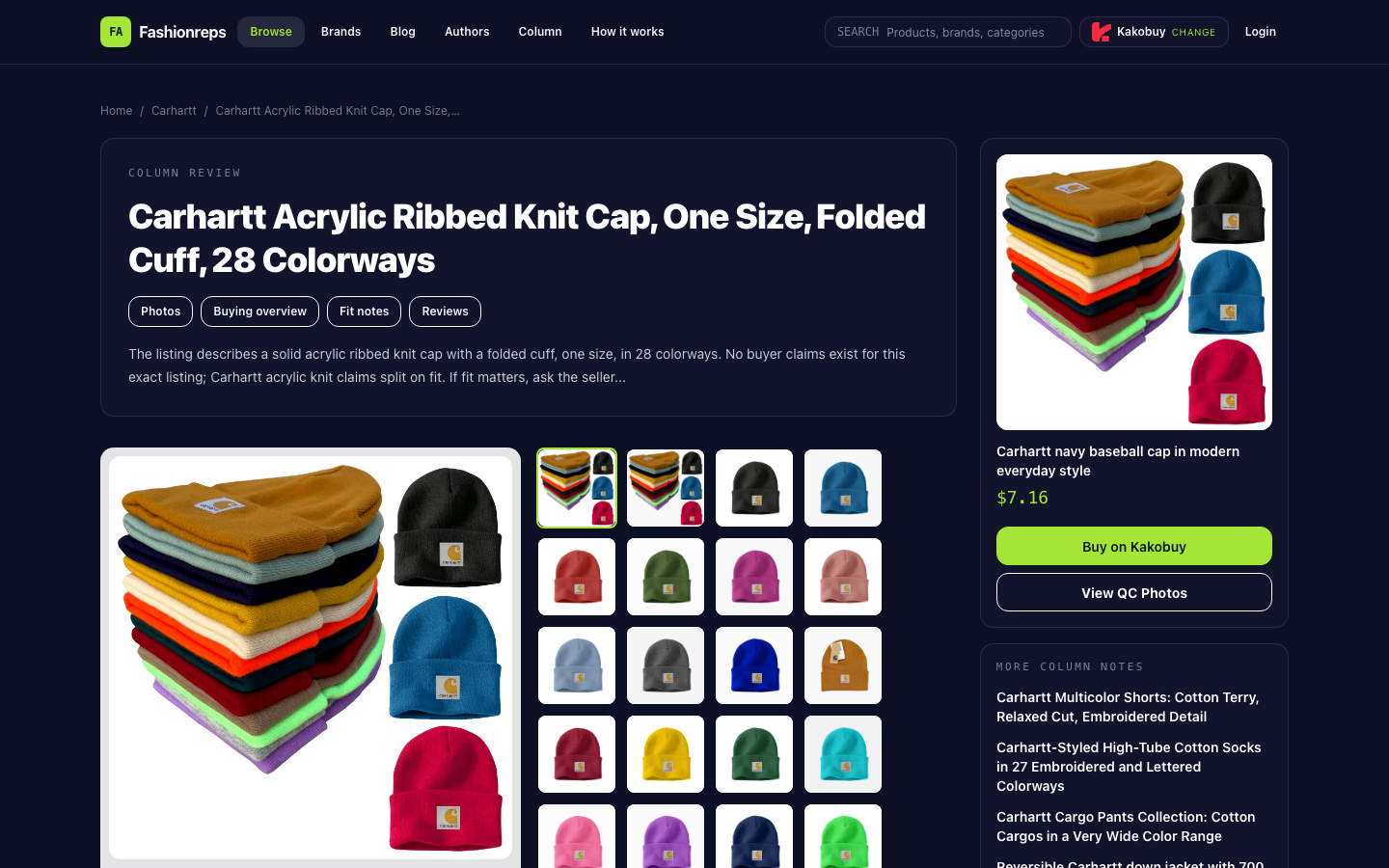
The page title calls this navy Carhartt item a baseball cap, but the product listing fields say no brim, cold hat, and describe it as an acrylic ribbed knit cap with a fold-over cuff. For someone ready to order, the first question isn't color or price, but confirming exactly which type of hat you're actually getting. 
First Judgement: Page Data Supports a Knit Cap More Than a Baseball Cap
According to the product page's catalog information, this item is described as acrylic material, ribbed knit construction, fold-over cuff, no brim, and listed as one size. The page also lists 28 colors, with navy being just one color option.
These fields are inconsistent with what is typically considered a baseball cap. A baseball cap generally should have a stiff brim, but the page's brim field explicitly says no brim, and the style field points to cold hat. The baseball cap in the title conflicts with the catalog description, so you can't rely solely on the product title to determine the hat type.
A more reliable conclusion is that the existing page evidence supports a brimless fold-over knit cap. If you need a brimmed style for sun protection, you should not place an order without confirmation.
Follow This Sequence to Verify Before Ordering
Step one, confirm the color. The page catalog lists a navy option, but on the order page you should still check that the selected variant actually corresponds to navy, and not a similar black, dark gray, or other dark color. The color word in the main image or title alone is not enough to confirm the final variant.
Step two, confirm the hat type. Ask the seller or shopping agent explicitly: Is the actual shipped item a brimless fold-over knit cap? You can also provide the page's no brim and cold hat fields, and require them to check the warehouse or product link, not just repeat the title.
Step three, request the unstretched hat circumference. The page only states one size, with no specific hat circumference for judging fit. Ask for the hat's unstretched circumference measurement, and inquire about the measurement location and margin of error. Do not interpret "one size" as suitable for all head circumferences.
Step four, confirm the fold-over cuff state. The height of the fold-over cuff affects ear coverage, forehead pressure, and overall appearance. You can ask about the height of the cuff when unfolded, and whether the fold position can be adjusted during wear. If the seller can only provide vague descriptions, the fit assessment remains limited.
Step five, check current QC photos. The page provides a QC Photos entry, but current data cannot replace the actual inspection after the order arrives at the warehouse. Before purchasing, you can confirm whether there are recent photos of this color and style; after receiving the item, you should check the actual structure corresponding to the brim field, whether the ribbing is even, and whether the stitching and fold-over cuff have obvious deformation.
Whether One Size Fits Cannot Be Determined by Brand Name Alone
The buyer feedback aggregated on this page is inconsistent regarding tightness. One feedback considers similar Carhartt knit caps decent quality for the price, but feedback on fit tightness is divided: some find the hat too tight, possibly causing head discomfort; others find it fits larger head sizes, and some call it small.
The page also mentions that different production batches of the A18 knit cap may have size variations, with newer batches considered looser than older ones. However, this information cannot replace actual measurements of the current item, nor guarantee that you will receive a specific batch.
Therefore, whether one size fits depends mainly on three unknowns: your head circumference, the hat's unstretched circumference, and the actual stretchability of the knit fabric. If you are sensitive to pressure or have experienced knit caps being too tight, the unstretched circumference should be a necessary confirmation before ordering.
How to Make a Fit Assessment
You can first measure your head circumference with a soft tape measure: wrap the tape around the wider part of your forehead, above the ears, and the most prominent point of the back of the head, keeping it snug but not tight. Record the head circumference for daily wear, then compare it with the seller's unstretched hat circumference.
If the seller only gives descriptions like "good elasticity," "unisex," or "one size fits all" without providing measurement numbers, these words are only marketing generalizations and cannot prove comfortable wear. For those whose head circumference is close to the upper limit of the one-size range, it's best to treat uncertainty as a purchase risk rather than assuming knit stretch will solve the problem.
Also distinguish between "can put it on" and "suitable for long-term wear." Even if the hat can be put on, if the fold-over cuff continuously presses on the forehead or ears, it may still be unsuitable for daily use. The existing page data only shows that buyer feedback is divided; it cannot judge comfort for specific wearing durations for you.
Price Can Be Referenced, but Cannot Replace Product Confirmation
The page shows a reference price of $7.16, along with a final product price field of $8.58. The page also states that service fees and international shipping need to be confirmed on the shopping agent website. Therefore, these numbers cannot be directly regarded as your final payment amount, nor can they be used to infer inventory, shipping, or total cost.
When the price is low, you should confirm the product identity even more. If you actually need a brimmed baseball cap, even if the knit cap itself is reasonably priced, it cannot solve the problem of buying the wrong hat type.
Situations Where Buying Is Appropriate vs. Situations to Pause
If you want a solid-color, brimless, ribbed knit, acrylic hat with a fold-over cuff, and are willing to confirm the unstretched hat circumference before purchase, this item can continue to be verified. Navy is suitable for understated styling, but the color choice itself cannot eliminate the uncertainty of hat type and size.
If you need a brimmed hat for sun protection, you should pause the order and first have the seller confirm the actual shipped structure. When the title and catalog fields are inconsistent, you cannot treat baseball cap as reliable proof of hat type.
If you expect one size to guarantee comfort without measurement, it is also not recommended to buy directly. Existing buyer feedback is inconsistent on tightness direction, and the page does not provide enough specific hat circumference data to make a definitive judgement.
Conclusion
This item currently appears more like the brimless fold-over knit cap described in the page catalog, rather than the baseball cap stated in the title. The key to judging whether it is worth buying is not the brand name or reference price, but first verifying the actual hat type, then obtaining the unstretched hat circumference, and checking the corresponding color and recent QC photos.
Before seller confirmation, the safest decision is to treat it as an item with potential hat type mislabeling and size uncertainty. If you need a brimmed style, pause the purchase; if you accept a brimless knit cap and can complete size confirmation, then consider ordering.