Introduction When buying Calvin Klein fall/winter underwear, the most common mistake isn't finding a familiar-looking logo—it's failing to match style, color, size, fabric details, and item evidence item by item. The page title may be broad, the images may show a different variant, and the size options may only represent the seller's own numbering. This gui
Introduction
When buying Calvin Klein fall/winter underwear, the most common mistake isn't finding a familiar-looking logo—it's failing to match style, color, size, fabric details, and item evidence item by item. The page title may be broad, the images may show a different variant, and the size options may only represent the seller's own numbering.
This guide addresses a specific task: before placing an order on a fashion-reps product page, create a verification record that can be rechecked. Once complete, you should be able to determine whether the current page is suitable for further inquiry, a temporary hold, or if it's unsuitable for purchase due to insufficient key information.
This article applies to pages that are still accessible, with a clear product name and visible product information. It does not apply to dead links, pages with only tags but no product details, or scenarios that rely solely on brand impression to judge authenticity or comfort. Price, stock, size options, seller information, and link status should all be re-verified before actually placing an order. The verification date recorded in this article is October 19, 2026.
Defining the Size Verification Task for Calvin Klein Fall/Winter Underwear Before Purchase
First, write the problem as an executable sentence, rather than just noting "want to buy Calvin Klein underwear." It is recommended to limit the task to: confirm whether the specific style, color, and size displayed on the current product page match your own measurement data, and confirm whether the page evidence is sufficient to support further inquiry or purchase.
After completing the verification, you should obtain at least one of three outcomes:
- Continue: The style, variant, size chart, and images correspond to each other, and the remaining risk is acceptable.
- Inquire: There are one or two key gaps, such as a size chart lacking units or images unable to confirm color, requiring confirmation from the seller or shopping agent.
- Pause: The page is invalid, variants conflict, size information is severely missing, or the product evidence cannot support your purchase judgment.
Do not treat "the page looks authentic" or "the images are clear" as proof of size fit or fabric comfort. Page evidence only proves what the page displayed at the time, and cannot automatically prove all attributes of the actual item.
Recording Style, Color, Size, and Current Link from the fashion-reps Product Page
fashion-reps helps users discover product pages, view source-based product information and QC photos, and learn about selectable third-party shopping agents. According to the page description, orders, payment, and logistics are handled by the user-selected agent website. Therefore, the product page and the agent website bear different factual scopes: the former mainly helps discover and verify product information, while the latter involves ordering, payment, warehouse processing, and shipping processes.
When opening the page, save the following fields first, and do not draw conclusions from images prematurely:
- The current page title and full page URL.
- The product category displayed on the page, such as underwear, thermal underwear, tank tops, or other styles.
- The colors, sizes, set quantities, and variant names listed on the page.
- Whether the page displays seller, source number, update time, or other traceable fields.
- Whether the page can open product details, QC images, or other related content.
- Verification date, destination country, and currency used.
If the page redirects, returns a 404, only displays category tags, or lacks a clear product name and visible information, do not count it as a valid product sample, and do not use search snippets to fill in missing fields. Link status changes quickly, so when saving records, note "accessible as of verification date" rather than writing it as permanently valid.
An example record can use the following format:
| Verification Field | What to Record | What Cannot Be Directly Inferred |
|---|---|---|
| Product Name | Full name currently displayed on the page | Cannot confirm actual material or authenticity based on name alone |
| Variant | Color, size, set, and option text | Cannot assume the main image color applies to all variants |
| Page Evidence | Product images, size chart, description, QC images | Cannot treat a single image as a complete quality inspection report |
| Current Status | Access time, stock notice, and link status | Cannot guarantee stock will remain after publication |
| Transaction Stage | Selected agent, payment, and logistics entry | Cannot use fashion-reps page as order proof |
How Product Title, Variant Options, and Images Correspond One by One
The title is usually a filter entry, not a complete specification. First, break the title into category, series or style description, color, and possible quantity information, then compare with variant options one by one.
Focus on checking the following conflicts:
- The title says multi-color set, but the options only show single color or single piece.
- The main image shows a dark color, but the variant list has no corresponding dark option.
- The title says fall/winter or thickened, but the details have no description of thickness, lining, or applicable scenario.
- Option names are only S, M, L, without units, body measurements, or measurement methods.
- The same page mixes multiple styles, but images do not indicate which variant each image corresponds to.
When a conflict is found, record it as is, then ask specific questions. Do not guess to make the record look complete. For example, instead of writing "Black size M is available," write "The main image contains a black style, but the current variant list cannot confirm black size M; need to check inventory and option correspondence."
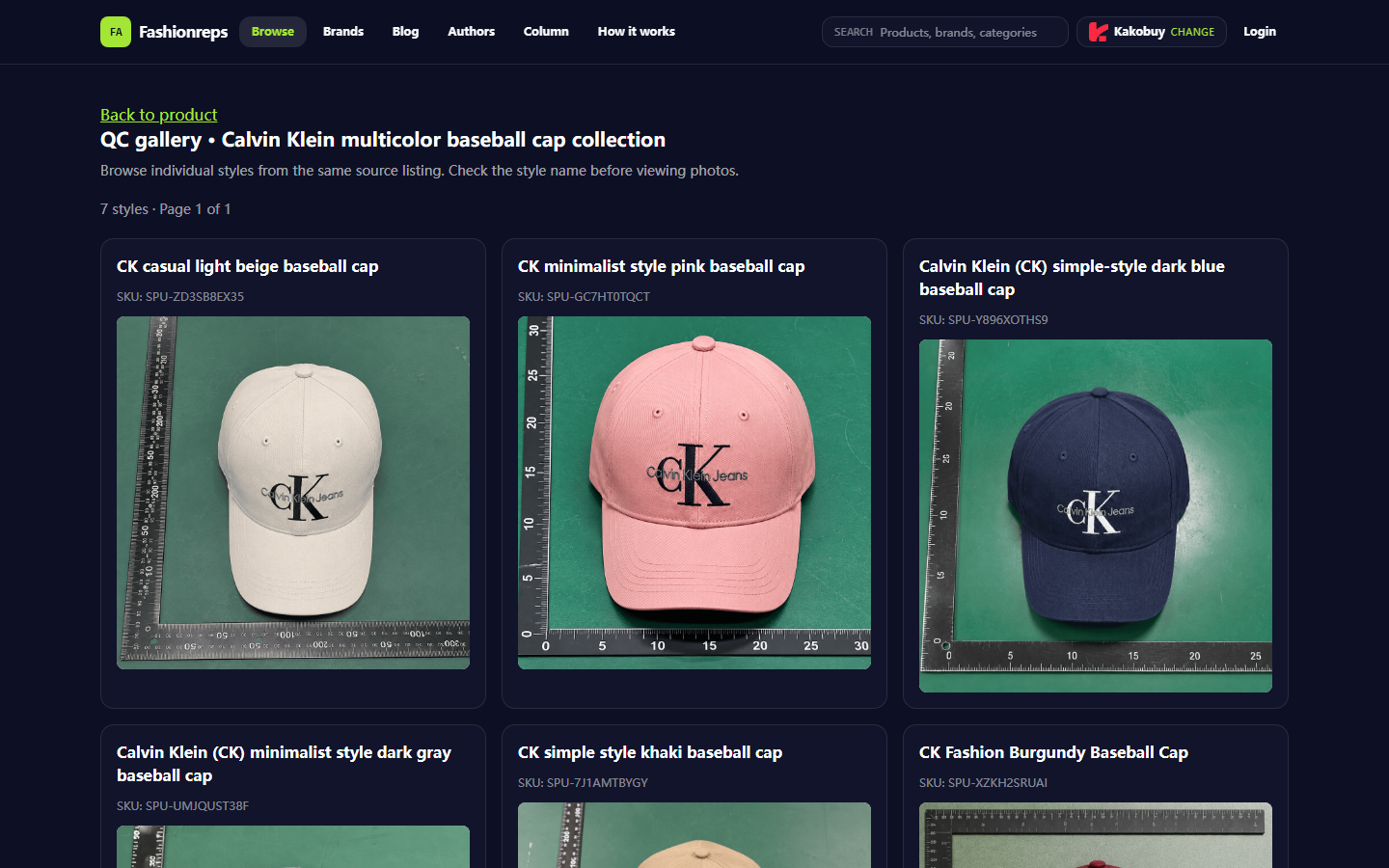
The image below shows the page structure for viewing images by style in the fashion-reps QC page. It helps understand the verification order of "confirm style first, then view corresponding photos," but the example is a Calvin Klein hat collection, not the fall/winter underwear evaluated in this article, and cannot serve as evidence for underwear size, fabric, or fit.

When QC images are viewable, confirm the image title or style name first, then determine whether the photo belongs to the target variant. If a source page contains multiple styles, avoid applying photos, colors, or details from one style to another. 📷
How to Build a Cross-Reference Between Size Chart, Fit Description, and Personal Measurements
Size verification should start with body measurements, not from the letter size you usually wear. Different sellers, fits, and country size systems may vary, so "usually wear M" can only be an initial clue.
It is recommended to prepare the following measurements and record units:
- Waist circumference: Measure at the position where the garment actually fits, without holding your breath or over-tightening the tape measure.
- Hip circumference: Measure the widest part of the hips, keeping a natural standing posture.
- Height and weight: Only used as auxiliary information, and cannot replace waist and hip circumferences.
- Flat-lay measurements of an existing well-fitting underwear: Including comparable items such as waistband width, crotch length, and leg opening.
Place personal data and the page size chart in the same record, keeping at least the original units and converted units. If the page only gives garment flat-lay measurements, clearly note that these are garment dimensions, not body dimensions; if the page only gives recommended weight, do not treat it as a precise waist or hip range.
Fit also affects selection. Low-rise, regular-rise, and high-rise have different fit positions; loose, slim, and stretch fabrics have different tolerance ranges. If the page does not clearly explain the fit, list fit judgment as an unconfirmed item, rather than inferring from model photos.
A practical judgment record can be written as follows:
- Whether the page size chart has units.
- Whether the page numbers represent body measurements or garment flat-lay dimensions.
- Which range your measurements fall into.
- When two sizes are close, whether the page explains fit and stretch.
- Whether there is a situation where waist matches but hips do not.
- Whether you need to confirm shrinkage, stretch, or measurement error with the seller.
If page data clearly conflicts with personal measurements, prioritize pausing and asking, rather than using brand conventions to replace the current product's actual data. 📏
What Can Be Verified About Fabric, Thickness, Stretch, and Wear Scenario
Product descriptions can help confirm what the seller claims, but cannot alone prove the actual item will perform the same. Fabric composition, weight, thickness, and stretch all need to distinguish between "clearly recorded on the page" and "no evidence on the page."
What can be directly recorded includes:
- Fiber composition and percentage clearly listed on the page.
- Thickness, brushed, warmth, or breathability descriptions clearly stated on the page.
- Stitching, waistband, tags, and surface appearance visible in QC images.
- Whether the page provides measurement methods or error descriptions.
What cannot be confirmed from static images alone includes:
- Whether it feels soft or itchy against the skin.
- Whether it is stuffy, breathable, or prone to deformation after wearing.
- Whether elastic recovery is stable.
- Shrinkage and pilling after multiple washes.
- Actual warmth in low-temperature fall/winter environments.
Therefore, in articles or purchase records, use expressions like "page labeled," "image shows," "to be confirmed," and avoid writing as if you have personally worn or tested it. Edited content can only be based on visible pages, measurement records, and clear sources, and cannot fabricate purchase, receipt, or try-on experiences. 🧵
What Product Page, QC Images, and Community Feedback Can Each Prove
The product page is suitable for confirming title, options, seller description, and page status. QC images are suitable for checking appearance details visible in a specific batch or order photo, but they do not necessarily represent every variant on the current page. Community discussions can help discover common questions, but cannot replace fact-checking of the current product page or current order.
When using community feedback, record the source of the discussion, publication time, number of comments, depth of replies, and whether it was fully read. If comments are deleted, replies are collapsed, discussions are too long, or technically impossible to read completely, mark it as partially read, and do not generalize a few comments into a conclusion for the entire community.
Do not turn a single highly upvoted comment into a universal rule, and do not turn "someone said it fits" into all buyers being suitable. For size, shrinkage, quality, and shipping performance, prioritize evidence related to the target style, target batch, and target region, and preserve uncertainty.
On the fashion-reps page, the value of QC images is mainly to help view photos related to the source product. If the page shows multiple styles, confirm the style name first, then open the corresponding images. Only describe what is visible in the images, such as color, whether stitching is visible, whether tags appear in the frame; do not write content that cannot be seen. 🔍
How to Organize Questions to Confirm When Information Is Missing or Fields Conflict
When asking the seller or shopping agent, the more specific the question, the easier it is to get a verifiable answer. Don't just ask "Is this real?" or "Is the quality good?" because such questions lack verifiable criteria.
You can prioritize asking:
- Whether the target color and target size are still selectable, and whether inventory needs real-time confirmation.
- Whether the numbers in the size chart represent body measurements or garment flat-lay dimensions.
- Measurement positions and allowable error for waist, hips, length, or inseam.
- Whether the fabric composition claimed on the page applies to all colors and all sizes.
- Whether the main image, variant options, and QC images belong to the same style.
- Whether there are known descriptions of shrinkage, color differences, or batch variations.
- If the size is not right, what are the return/exchange conditions of the agent or seller, and how are the applicable time window and costs calculated.
Tie each question to a page field. This way, after receiving a reply, you can directly fill it back into the record, rather than just saving a chat content that cannot be traced. When involving order numbers, payment information, addresses, or personal identification, do not upload complete screenshots in public discussions; if evidence needs to be shown, cover personal information while retaining key fields that do not affect judgment.
Final Step: Save the Verification Checklist and Decide to Continue, Inquire, or Pause
Before placing an order, reopen the page and confirm that previous records did not mix different products or different variants. Save the page title, current link, variants, size basis, image evidence, and questions to confirm, and note the verification date.
You can use the following final checklist:
- [] The current page is still accessible and is not a pure category or tag page.
- [] Product category, style, and target color have been clearly recorded.
- [] The target size does appear in the current variant options.
- [] Size chart units and measurement subject have been confirmed.
- [] Personal waist, hip, and necessary auxiliary measurements have been recorded.
- [] Page description, variant names, and images have no unexplained conflicts.
- [] Fabric, thickness, and stretch are only recorded to the extent supported by the page.
- [] QC images have been confirmed to belong to the target style, or clearly marked as not applicable evidence.
- [] Price, stock, agent fees, shipping, taxes, and return/exchange conditions will be re-verified before actual ordering.
- [] All uncertain items have been converted into specific questions.
If all key items correspond to evidence, you can continue to the agent website's ordering and payment process, but still cannot regard page verification as a physical guarantee. If only one piece of information that can be clearly asked is missing, ask first, then decide. If size, style, or current link cannot be confirmed, pausing the purchase is usually safer than taking on an erroneous order that cannot be returned or exchanged.
The final trade-off is very specific: spending a few minutes saving page fields and personal measurements mainly saves the cost of choosing the wrong size, wrong variant, and communication costs due to insufficient evidence; the added cost is recording time and waiting for seller or agent confirmation. It is suitable for people who value fit, need cross-border purchases, or are preparing to combine multiple items. It is not suitable for people who do not care about size differences at all, cannot provide personal measurements, or cannot accept the risk of page information changes.