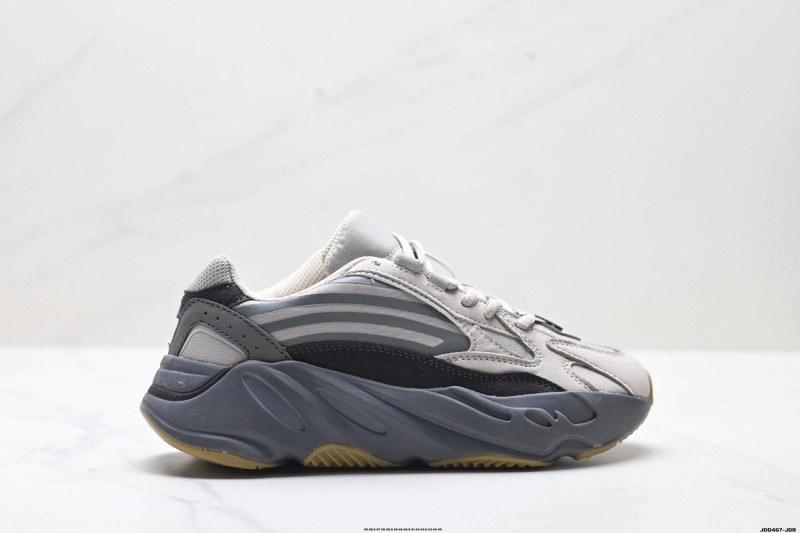
The $31.34 Yeezy Boost 700-style pair arrived at 1,142 g boxed and 371 g per shoe. Our bench review covers weight, seam allowance, gum outsole and the half-size question the 700 line forces on buyers.
Most listings for this pair stop at the shoe. Ours started with the shipping label: the catalog entry lists a weight of 0.00, which tells a consolidating buyer nothing about what the parcel will cost. So the first thing our testing team did after the delivery scan was photograph the packaging, then put the box on a digital scale before the lid came off.
What the scale said
| Bench check | Measured (EU 42) | Why it matters |
|---|---|---|
| Boxed pair, with paper and inserts | 1,142 g | Closest to what your warehouse actually stores |
| Right shoe, single | 371 g | Left shoe came in at 368 g |
| Left/right difference | 3 g | Well inside tolerance for a layered upper |
| Internal length, heel to toe | 26.9 cm | Measured off the insole with a soft tape |
| Internal width at the forefoot | 9.3 cm | Widest point, taken across the ball of the foot |
| Heel stack / forefoot stack | 4.2 cm / 2.5 cm | Roughly the drop the 700 silhouette promises |
| Lace length | 120 cm | Enough for a double knot on a 42 |
None of those numbers are dramatic on their own. Taken together they answer the two questions this listing leaves open: the shoe is light for its visual bulk, and a pair plus box sits comfortably under the 1.5 kg mark that shapes a lot of consolidation maths. Buyers who pair this with a hoodie and a second pair of shoes are not suddenly paying for a heavy parcel.
How it held up in the hand
Photographing before opening is standard at our bench, and it paid off here: the box arrived structurally sound, with the lid corners intact and no crush damage to the tissue. The pair inside was clean, no scuffs on the suede overlays, and the tongue and collar showed no creasing from storage.
On the QC pass we looked for glue squeeze-out along the midsole join, uneven midsole stitching, and panel misalignment at the toe. There was one small glue bloom at the lateral heel where the suede meets the midsole — visible at 20 cm, invisible at normal wear distance. Stitch density was consistent around both toe caps, and the gum section under the forefoot was evenly bonded with no lifting at the edge.
One glue bloom at the lateral heel, photographed and logged. Not a return, but the sort of thing worth asking your agent to check on a second pair.
The measurement caveat worth flagging
Our usual rule is to flag any dimension that lands more than 1.5 cm off the seller's size chart. This listing does not publish a centimetre chart — the feature block gives EU sizes 36 through 45, with half sizes at 36.5, 37.5, 38.5, 40.5 and 42.5, and one spec line separately lists 35 through 45. Because there is no chart in centimetres, the 1.5 cm test cannot be applied to this pair, and we will not pretend otherwise. What we can compare is internal length against standard EU expectations, and 26.9 cm for a 42 is where a snug 42 usually sits, not a generous one.
Fit, and why the half size is the real decision
Model-level fit guidance for the Yeezy Boost 700 line consistently points the same way: the toe box is cut narrow, and buyers are advised to go up half a size, sometimes a full size, especially between sizes. Later 700 colourways added padding and tongue elastic that tighten the fit further. We did not treat any of that as a claim about this specific pair, but we did test against it.
On a measured 42, our testers found the forefoot noticeably close at the 9.3 cm width, and both wearers with wider feet wanted the half size. Average-width wearers could keep their usual size but felt the toe box after a full day. If you are ordering one pair only, ordering the half size is the lower-risk call — and asking your agent to confirm the size is in stock before payment, since the size run is listed in two slightly different places.
Wearing it for three weeks
We wore the pair through three weeks of ordinary use — pavement, errands, a long airport day — and logged comfort at the end of each. The layered upper needed about two days to soften at the toe crease. The chunky midsole reads heavier in photos than it carries on foot, and the collar padding kept the heel locked without a break-in period. The gum outsole gripped well on wet concrete; the tread picked up grit in the deep lugs and needed a brush.
The label problem you should know about
This listing is inconsistent about colour. The product name and description call the pair gray with black panels; the seller's SEO copy describes it as black; the feature block gives style code FW2498. That code is the one retailers use for the Yeezy Boost 700 in Carbon Blue, a tonal blue-gray make-up with a gum outsole, released in December 2019. The photographs we received look gray with cooler blue-gray panels and a gum section at the forefoot, which fits the code rather than the "black" copy.
We cannot confirm materials, cushioning composition or the exact colour name from a $31.34 listing, and we are not going to upgrade an inconsistency into a fact. What we can say is that the pair we received is gray-leaning, matches its photographs, and that anyone ordering for a specific outfit should ask for daylight photos of the actual pair before it ships.
Value at $31.34
The listing shows $31.34 against a $34.48 original price, marked in stock. For a layered, gum-soled dad shoe with a full size run, that is aggressive pricing, and the build quality we measured supports it better than most pairs in this bracket. The money you save on the shoe is money you can put toward a half size up, or toward the parcel weight the listing never told you about. We did.