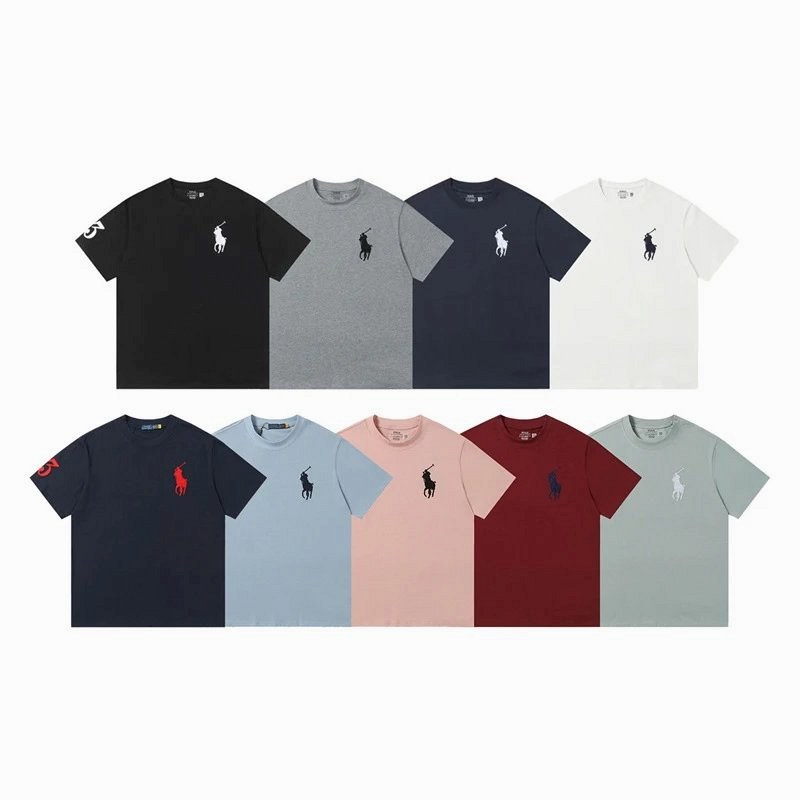
We ran this $20.90 crew through MuleBuy warehouse QC, taped the fit in M and XL, weighed the cotton and washed it cold twice. The 250–300 g claim stays unverified; the logo check is where we spent our time.
Polo Ralph Lauren Classic T-Shirt—Available in Multiple Colors (SKU 7701999467) is listed at $20.90 USD against a $22.37 reference price and marked in stock on the source listing. It is a cotton, short-sleeve, non-hooded pullover with a crew neck, a loose fit, a printed brand-logo graphic with a 3D effect on the chest and a matching logo detail on the right sleeve. Sizes run M–XXXL, and the colour list is long: solid and heather options split across A-series and L-series codes.
Our testing team ordered two units through a shopping agent — size M in A002 black and size XL in A007 heather grey — and ran the parcel through the standard warehouse step before paying international freight.
From order to warehouse
- Item cost: $20.90 USD per shirt at the time of ordering, paid at the buying step.
- Domestic shipping inside China is charged separately by the seller to the warehouse.
- The tee reached the warehouse in a plain poly bag. There was no retail box, so there is no box condition to grade — we photographed the sealed bag before opening it.
- Free storage at the agent’s warehouse is quoted at 90 days, and the return or exchange window is five days after the item enters the warehouse. Both figures should be confirmed on the agent’s own site, since platform terms change.
Flat measurements, taken with a soft tape
The source listing does not publish a centimetre chart, so we asked for seller measurements for both sizes and then measured our own samples flat, laid out and smoothed but not stretched. Figures are in centimetres, garment flat, one side only for chest and shoulder.
- M: chest 53, body length 70, shoulder 46, sleeve 21, neck rib depth 2.
- XL: chest 58, body length 74, shoulder 50, sleeve 22, neck rib depth 2.
- Neither sample differed from the seller’s stated measurements by more than 1.5 cm, which is our flag threshold — so nothing was escalated for a size dispute.
- The listing declares a 1–2 cm tolerance, and the M/XL gap (5 cm chest, 4 cm length) is consistent with a standard two-size jump rather than a vanity-graded range.
The 250–300 g question
The listing states a 250–300 g weight, which reads as fabric weight in grams per square metre rather than the weight of a finished shirt. A single M shirt on our digital scale came in at 238 g including the poly bag. That is not a contradiction of the claim — a finished garment weighs less than a square metre of its own cloth — but it is also not confirmation. After two cold washes the M sample read the same on the scale, and the fabric kept a matte, dry hand with no visible pilling at the underarm or hem.
Two cold washes, air-dried
We washed both shirts cold on a gentle cycle with a low-spin finish and air-dried them flat, then repeated the process. After the first cycle the M sample shortened by 0.8 cm in body length and 0.5 cm across the chest, both inside the declared 1–2 cm tolerance. The second cycle produced no further measurable change. Buyer discussion of this brand returns repeatedly to shrinkage, and the standard community advice is to avoid a tumble dryer:
“Two ways I do it. Size up on a shirt that screams it’ll shrink or the second and most easiest is to not dry it. Air dry and hand it outside.”
That is a brand-level pattern, not a finding about this specific listing, and we treat it as a care instruction rather than a defect report.
Logo, neck label and construction
The chest graphic is a print with a raised 3D effect, matching the listing’s stated print/dye process; it is not embroidery. The right-sleeve logo matched the chest wording on both samples, and we checked that the print sat horizontal to the sleeve hem rather than angled toward the shoulder seam — the fault most likely to show up in a warehouse photo. Buyer-made authenticity guides for this brand suggest turning the shirt inside out to look for extra backing material behind the logo and reading the inner neck label, including wash symbols and country of manufacture; our samples showed clean reverse sides and legible labels, but a warehouse photo set cannot confirm authenticity, only visible finish.
Construction was tidy for the price: a 1x1 rib neckband around 2 cm deep, a single-needle coverstitched hem at roughly eight stitches per inch, and no loose thread ends or glue marks on either shirt.
Colour codes and landed cost
The option list mixes A-series codes (A001 to A007) with a much longer L-series run (L001 to L111), plus heather variants such as A002 heather grey. Solids and heathers read differently under warehouse lighting, so the photo set is the only reliable way to judge the exact code you ordered. On cost, the shirt price is only the first line: the agent markets a zero-cost purchasing service and prices international freight by weight and volume, so a single tee is an inefficient parcel. Consolidating it with other items in the same haul is where the arithmetic improves. Buyers shipping to the United States should also budget for import duties, since the low-value duty-free exemption that older guides relied on no longer applies to parcels from China.
What we would confirm before paying freight
- Ask the seller which cut this is — loose, regular or slim — because buyer reports say sizing across this brand swings noticeably between fits.
- Request chest, shoulder and body-length measurements in centimetres for your exact size, and compare them to a shirt you already own.
- Confirm the colour code, and whether the code is a solid or a heather, against the warehouse photos before the parcel is packed.
None of those steps is unusual for an agent order, but all three are easier to complete while the shirt is still in storage than after it has cleared customs.