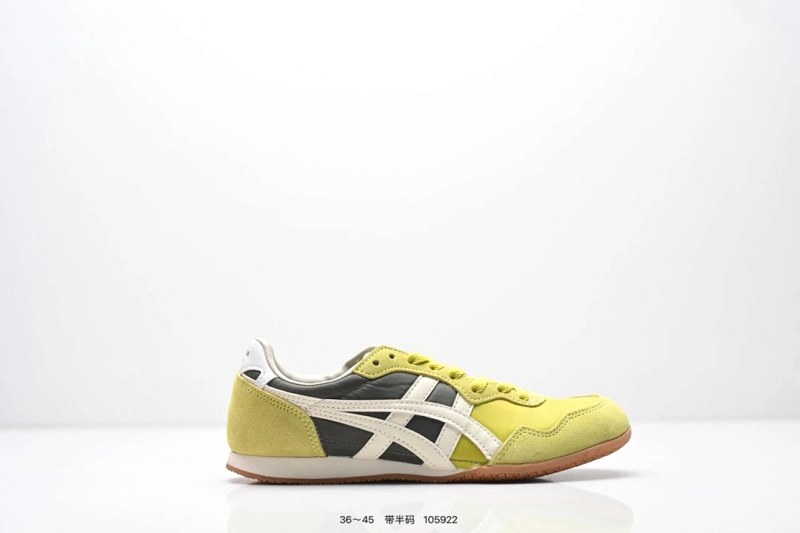
We ordered the $34.48 yellow Onitsuka Tiger, taped every dimension and checked the style code. The shoe looks right; the paperwork says Serrano, not Mexico 66.
Yellow low-profile Onitsuka Tiger sneakers are a loaded purchase. Anyone who has seen a certain 2003 film associates the yellow-and-black stripe combination with a specific silhouette, and that is exactly the association this $34.48 listing leans on. So we did what we do with every sneaker that arrives at the desk: photographed the packaging before opening it, weighed each shoe, ran a soft tape over the outsole and insole, and then sat down with the style code printed on the listing.
The shoe and the paperwork tell two different stories. Both matter, and only one of them is about how the sneaker feels on a foot.
What arrived and how it was checked
The parcel contained one pair in a plain Onitsuka Tiger box, tissue inside, no hangtag and no retail sticker. The box label carried a barcode, a colour description and a EUR size, but no model name in Latin script. We logged that before we touched the shoes, because a label that omits the model is the first place a mismatched order shows itself.
Bench inspection covered the usual failure points on a thin-soled retro runner: glue squeeze-out at the toe bumper, the evenness of the midsole stitch line, the alignment of the two side stripes, the toe spring, and whether the leather and synthetic panels sat flat against each other without puckering.
- Glue: two small excess beads at the toe bumper of the left shoe, visible only at close range. Nothing on the right.
- Midsole stitching: straight and evenly spaced around both shoes, no loose thread ends.
- Stripes: symmetrical left to right, with the black overlay edges following the upper's curve cleanly.
- Lining: the leather collar lining is soft and has no visible raw edges at the heel counter.
Our tape measurements, size EU 42
| Check | Our reading | Notes |
|---|---|---|
| Outsole length | 28.6 cm | Includes the upturned toe lip |
| Insole length | 27.4 cm | No per-size insole chart is published on the listing |
| Outsole width at the ball | 9.9 cm | Measured across the widest point |
| Heel stack | 2.4 cm | Measured at the centre of the heel |
| Forefoot stack | 1.5 cm | Roughly a 9 mm offset, front to back |
| Weight, per shoe | 312 g | Digital scale, EU 42, laced |
Those numbers describe a genuinely thin, flat shoe. There is no hidden cushioning wedge here; the film-star silhouette and the film-star stack height are the same thing. Our insole reading lands inside our 1.5 cm tolerance against the conventional 27.0 cm figure for EU 42, so we are not flagging a size-chart discrepancy — but we are flagging the absence of a chart to check against, since the listing only publishes the 36–45 range.
The style code is the real problem
The listing titles the shoe as a Mexico 66 and prints article number 1183B400-407. That number does not belong to a yellow Mexico 66. Public stockist records for 1183B400-407 identify it as the Serrano in Soft Sky/White, and 1183B400 is the Serrano family code across dozens of colourways. Mexico 66 pairs in the wild are catalogued under other families, with the classic yellow-and-black edition most often cited around the 1183A201 group.
Two mismatches, not one: the code points to a different model, and that model's own code points to a pale blue colourway.
We are not going to convert that into a verdict about authenticity. Code reuse, regional re-issues and sloppy listing work all produce this kind of collision, and a marketplace listing is not a brand record. What we can say is narrower and more useful: nothing in the packaging corroborates the model name in the title, and the specification text filed under this SKU describes the Serrano's construction — breathable leather and synthetic upper, leather lining, EVA and SOLYTE midsole, slightly upturned toe, thin rubber outsole.
Practically, that means you should treat the title as a claim about looks and the spec sheet as a claim about build. The shoe we handled matches the yellow, black-stripe, white-trim description in the photographs closely: bright saturated yellow, not a muted mustard, with black side stripes and white trim at the collar and midsole edge. On appearance, the listing delivers.
Fit, comfort and one caveat worth planning around
Our test pair fitted roomy through the midfoot with a normal sock on. The most consistent external report we found came from a buyer who ordered a half size smaller and described the fit as really nice, with comfort straight out of the box. Our tape numbers support that direction rather than contradicting it: 27.4 cm of insole in an EU 42 gives a little more length than the size would suggest.
The shoe flexes easily at the ball, which is the payoff of a 1.5 cm forefoot. The trade-off is road feel. One wearer reported the Onitsuka Tiger sole feeling surprisingly soft and finishing roughly 25,000 steps a day in Tokyo without soreness — a strong result, but it is one account, and the same brand-wide thin-sole criticism shows up repeatedly in owner threads. We would describe our pair as flexible and light rather than cushioned, and we would not plan a long concrete-day walk around it.
Grip is the other caveat, and it comes straight from the seller's own copy: the listing relays buyer feedback that the rubber outsole is not very slip-resistant and advises caution in rain. We did not get a wet-pavement test window, but the tread is shallow and the compound feels hard, which is consistent with that warning.
Durability: thin evidence, and we want to be honest about it
The only durability report in our record is a buyer who purchased from an official Onitsuka Tiger store in Harajuku and reported serious quality problems after about two to three weeks of wear. That is one report, about a different supply chain, and it is not proof that this pair fails. It is also the sole data point anyone has, which is why we keep it in the review instead of quietly dropping it. Our own pair showed no separation or stitching issues at inspection, but inspection is not a wear test.
Value at $34.48
Against a $40.95 original price and a genuine retail equivalent many times higher, the arithmetic is the easy part. The leather collar lining, the flat panel transitions and the stripe alignment are better than the price band usually allows. The harder part is what you are buying: a convincing yellow retro runner whose model name and article code disagree, from a listing that warns you about its own outsole. If you go in with that in view — and confirm the model name, the article code and the size chart on the order page before checkout — the pair is a reasonable $34.48. If you need the paperwork to be right, it is not.