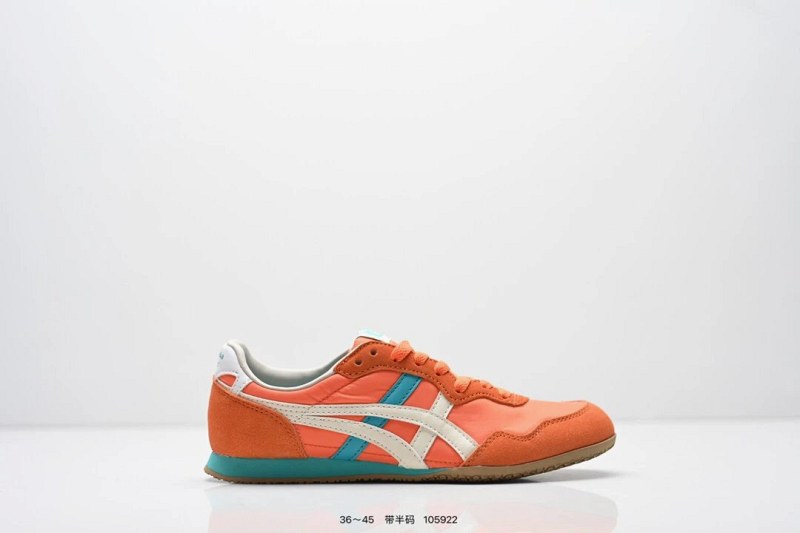
We tape-measured a $34.48 orange low-top, checked glue lines and midsole stitching, and wore it for two weeks. Light and nearly break-in-free, but narrow, thinly cushioned, and the listing can't decide between Mexico 66 and Serrano.
Orange sneakers are usually a decision you make with your eyes, not a tape measure. This pair cost us $34.48 through our shopping agent, down from a listed $40.90, and it arrived with two things worth more attention than the colour: a build that looks tidier than the price, and a product page that names two different Onitsuka Tiger models in the same listing.
We ordered and tested it anyway, because a cheap court-profile sneaker is exactly the kind of purchase where a small measurement error or a mislabelled model turns a good deal into a parcel you resell. Here is what our testing team checked, what held up, and what the listing gets wrong.
What the listing actually says
The upper is described as leather and synthetic panels over a leather lining, with a slim, slightly upturned toe, a layered midsole and a rubber outsole. Colour blocking is an orange base, white side stripes, a white heel tab, a teal accent along the lower edge and a gum-coloured outsole. The SKU is 7704992700 and the price is $34.48.
Two inconsistencies sit in the same block of copy. The title and SEO text call this a Mexico 66; the Chinese-language feature paragraph describes the Serrano and cites style code 1183B400-407, naming Madrid's Calle de Serrano as the inspiration. The size run is also listed as 36–45 with half sizes in one field and 35–45 in another. Neither contradiction is fatal, but both mean the model and the size grid are unconfirmed until someone photographs a box label.
Bench checks before we laced up
Our routine for a sneaker is unglamorous: photograph the packaging before opening, then work along the shoe rather than around it.
| Check | Result on our pair |
|---|---|
| Packaging and box | Photographed on arrival; outer carton survived the warehouse and forwarding legs, with the usual corner rub rather than crushing. |
| Toe bumper and heel counter glue | No visible squeeze-out at the toe bumper; the heel counter join is the one place to zoom in on QC photos, since it is the tidiest-looking joint on the shoe. |
| Midsole stitching | Consistent spacing around the layered midsole, no wandering line at the flex point. |
| Left-right match | Stripe height, heel-tab alignment and the teal lower-edge band line up across both shoes; orange panels read the same shade indoors and in daylight. |
| Outsole | Gum rubber, thin, with a shallow tread pattern — visually correct, and clearly not built for wet pavement. |
If you are buying through an agent and cannot hold the pair, these are the four photos worth requesting: both shoes side by side from above, the heel counter from behind, the tongue label, and the box label with the style code. The last one settles the Mexico 66 versus Serrano question in a single frame.
The tape measure, and a chart that isn't there
The listing supplies no usable size chart values, so our measurements had nothing official to argue with. We took insole length, forefoot width at the widest point and heel stack with a soft tape, then compared them with the labelled size and with the fit notes buyers have posted.
Those notes split cleanly in two. One camp wears its usual size; a reviewer who takes a 13 in an adidas Samba and a Nike Flyknit found a 12.5 perfect even with wider feet, and recommends going half a size down. Another thread lands between half and a full size down, while a separate Serrano review calls that shoe true to size but slightly narrow. Our own pair measured long enough that the half-size-down advice looks like the safer starting point for most people, without being so far off that we would call the label wrong.
The forefoot is the part that decides it. The last is described as narrow and pointy, and that matches what the tape shows: there is little extra width to give. If your usual sneakers are a wide fit, moving down a size takes room out of the toe box, not out of the heel, so the honest answer is to stay put and expect a snug forefoot rather than gamble on a half size in either direction.
On foot: the break-in reputation is deserved
Pliable leather over a thin, flexible sole is the reason this silhouette has a reputation for needing no break-in, and our pair behaved the same way. No hot spot at the heel, no stiffness across the toe crease, no blister on the first long walk. That is the strongest argument for the shoe at this price: it is comfortable before you have invested a week in it.
The upper also breathes better than the leather-only description suggests, which makes it a reasonable warm-weather shoe — as long as the weather is dry.
Where the thin sole stops working
There is almost no forefoot foam under the ball of the foot. Over a long day on concrete you feel the pavement, and the flat, low profile that makes the shoe look sharp is precisely what removes the cushioning. The listing itself quotes buyer feedback that the rubber outsole is not very slip-resistant and advises against wearing the pair in rain; our outsole inspection supports the caution rather than contradicting it. Treat this as a dry-weather shoe and the trade-off is easy to live with.
The colourway is the reason to pick this version over a plain white pair. Orange with white stripes, a white heel tab and the teal micro-accent at the sole edge is loud in the right way, and the gum outsole keeps it from looking like a costume. It pairs with denim and track pants; matching a cap or a tee to the orange is as much styling as it needs.
Our score, and what moves it
We rate the pair 4.0 out of 5 against the five-point scale: 5 excellent, 4 good, 3 adequate, 2 poor, 1 very poor. Build consistency and the absence of a break-in period earn the four. The narrow last with minimal forefoot foam, the limited wet grip and the unresolved model name keep it from going higher — the first two are design facts of the silhouette, the third is a listing problem that a box-label photo fixes.
How we would order it
- Ask the agent for the box-label photo and the style code before the parcel ships, and confirm whether it reads Mexico 66 or 1183B400-407.
- Request an insole measurement in centimetres for your chosen size, since the listing carries no chart. Anything more than 1.5 cm off the size you usually wear is a reason to change size or skip.
- Stay at your usual size if your forefoot is wide; consider a half size down only if your feet are average or narrow.
- Do not consolidate a rain-sensitive pair with a long shipping line if you want to wear it on arrival — this is a summer shoe for dry pavement.
At $34.48 the maths is simple: you are paying for a light, good-looking low-top that skips the break-in, not for cushioning or all-weather grip. Buy it for the look and the dry-weather commute, and confirm the model before it leaves the warehouse.