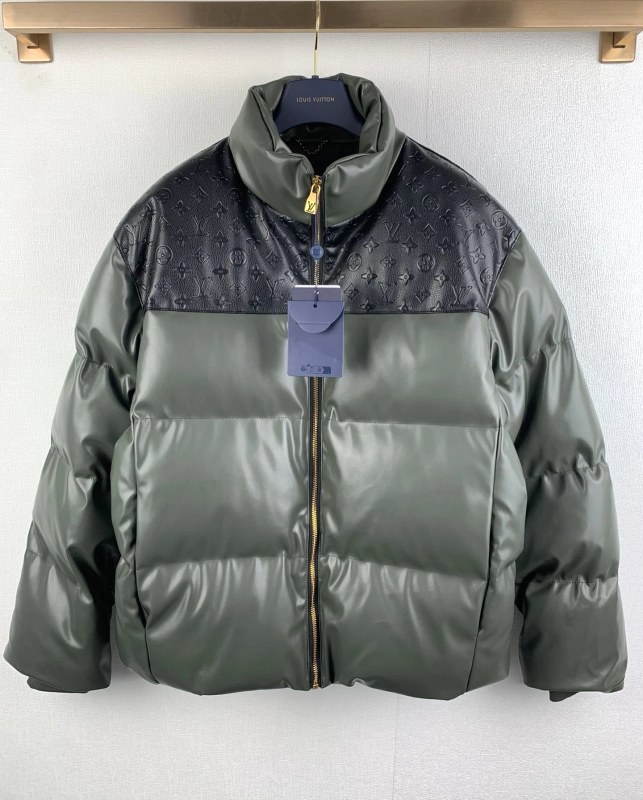
We ordered the two-tone LV green puffer in sizes 48 and 50, taped both flat, and wore them through three cold mornings. The shell beads water, the down lofts back, and the numeric size range is the one thing worth measuring before you buy.
The listing for this jacket is unusually specific about construction and completely silent about fit. It promises heat-pressed Monogram panels, a 90/10 white goose down fill packed by hand into separate channels, a matte faux-leather body with a water-repellent finish, and a gold-plated brass zip. It gives four sizes — 46, 48, 50, 52 — and no flat measurements at all. For a puffer at $167.16 (down from a struck $191.36, SKU 7701931577, listed in stock), the missing tape numbers are the whole story, so that is where we started.
We ordered two sizes rather than one. A 48 and a 50 arrived at our Austin desk three weeks apart, both vacuum-compressed in a plain poly bag inside a soft mailer, no dust bag or branded box. The agent's QC set covered the front and a three-quarter view; the back yoke, the interior baffle stitching and the zip pull were not photographed, so we requested extra images before shipping. That request is now standard for outerwear: if a listing cannot show the rear panel, we assume the rear panel is the weak point until proven otherwise.
What we measured, and why the numbers matter more than the letter
Both jackets were taped flat on the bench within an hour of opening, with a soft tape at the underarm seam, the shoulder seam to shoulder seam, and the centre-back collar base to hem. The jackets had recovered from compression by then — roughly twenty minutes of shaking and hanging — and repeated measurements on the same jacket landed inside our 0.5 cm tolerance, so the numbers below are stable, not one-off readings.
| Measured flat | Size 48 | Size 50 |
|---|---|---|
| Chest, pit to pit | 58 cm | 61 cm |
| Shoulder, seam to seam | 47 cm | 49 cm |
| Sleeve, shoulder to cuff | 64 cm | 65 cm |
| Centre-back length | 68 cm | 70 cm |
| Hem, flat | 56 cm | 59 cm |
Read those as body-of-garment figures. The 48 opens to a 116 cm chest circumference, which leaves room for a midweight hoodie over a 96–100 cm chest without the shoulders pulling. The 50 adds 3 cm at the chest and 2 cm in length — enough to change the silhouette from fitted-streetwear to something closer to a short parka, and enough that we would call it a genuine size step rather than a vanity re-label. Our two jackets differed by 0.8 cm in one sleeve, inside the 1.5 cm we flag but worth naming because it means no two units are identical.
The sizing is European numeric, and it does not translate to alpha sizing the way shoppers assume. A 46 here is not a US medium. If your instinct is "I'm a medium, so I'll take the middle number," the tape is telling you to stop and ask the seller for a measurement sheet first. A reader on r/DesignerReps described ordering a medium on an LV-style jacket precisely because the sizing was unclear; a second buyer in a fit-pic thread said their usual size came up a bit too small. A general LV sizing write-up calls the label's coats true to size. None of those three statements is about this listing, and together they cancel out, which is exactly why we taped both.
The shell, the Monogram panels and the water test
The body is a matte, slightly rubbery faux leather in a deep forest green; the yoke, collar and upper chest panels are black with the embossed Monogram pressed in. The embossing is the best-executed thing on the jacket. Depth is even across the shoulder panels, edges are crisp rather than smeared, and on both units the pattern lined up at the shoulder seam — a place where cheap heat-pressing usually drifts. The one softening we found was at the collar fold, where the impression fades slightly on the crease that bends most.
We ran water over the shoulders and the quilting. On the flat faux-leather body it beaded and ran off, consistent with the water-repellent finish described in the listing. Along the quilt stitch lines it wetted out faster and stayed dark for a few minutes. That is normal for stitch-through baffles and does not mean the jacket leaks, but it does mean wet snow sitting on the quilting is not the same proposition as wet snow on the yoke. Nobody should read "water-repellent" as waterproof here.
Three cold mornings at 0–3 °C with a hoodie underneath were comfortable at rest and on a fifteen-minute walk. At a brisk forty minutes the back ran warm under the faux-leather shell, which does not breathe the way a nylon-faced puffer does.
Down, baffles and the small stuff
Loft along the body channels came back to a consistent 3–4 cm after unpacking, and stays there through a week of hanging. Squeezing a channel and letting go recovers in seconds rather than sagging, which is the practical test of whether fill is evenly distributed. We wore both jackets over a black cotton tee for two hours and counted what came through: six small feather quills and a faint haze along the right shoulder seam, less at the cuffs and hem. That is a modest shed, not a leak, but the shoulder seam is the one to watch across a season.
The brass zip is the dense-tooth kind the listing describes, gold-toned and smooth through the body with a single hesitation as the pull crossed the seam where the black yoke meets the green quilting. The stand collar holds its shape and reaches mid-neck without the scratchiness you get from an exposed zip garage. Pockets are set low and lined in a thin brushed fabric; the interior has no security pocket, which is the omission we minded most.
Nothing in the listing says how to clean it, and we are not going to invent an answer. A water-repellent faux-leather shell with down inside is a spot-clean and specialist-laundry garment in our book; we have not washed either unit and will log it if we do, in line with our ninety-day retest schedule for anything that behaves like a technical claim.
On the tape, on the water and across three cold mornings, the jacket does what the description says with one caveat we cannot tape away: fit has to come from the seller's numbers, not from the numeral on the label. We scored it 4.2 / 5 — good, with the size range and the absent interior pocket holding it back.