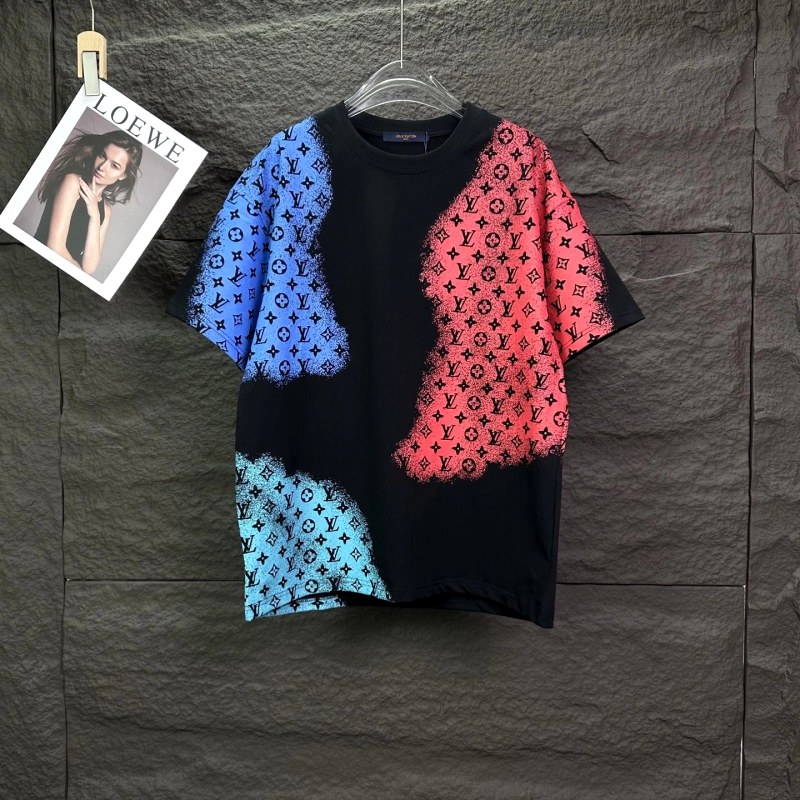
We ordered two black sizes of the $36.04 LV gradient tee, weighed the cotton, measured it flat and washed it twice. The 320gsm claim holds; the blue-to-red print loses contrast on a black base.
The gradient is the whole point of this shirt, and a gradient is the least forgiving thing you can print. A flat logo either lands or it does not; a blue-to-pink-to-red transition has to stay smooth across a body and two sleeves, and it has to do that on a black ground that swallows the darkest end of the range. We ordered the black colorway in two sizes at $36.04 (listed down from $43.02, SKU 7702169077) and spent three weeks finding out whether that transition survives the base colour it is printed on.
What we ordered and what the listing promises
The listing for this Louis Vuitton T-shirt describes a black body with an irregular gradient monogram graphic running across the short sleeves and the lower section, a classic crew neckline, and unisex sizing from S to XL in black or white. The seller's own copy goes further than the English translation does:
320gsm double-yarn pure cotton, digital direct-injection printing, packaging, hangtag, neck label and wash label all complete. Black and white, S–XL.
Both sizes arrived bagged with the hangtag, a neck label and a wash label inside, and the labelling was consistent between the two shirts. We photograph packaging before opening, so the bag condition and the tag set are on record.
The fabric, weighed rather than trusted
A 320gsm claim is easy to type and hard to check without a scale. We hung a 60 cm² strip cut from the hem allowance of the size L and weighed it dry at 1.9 g, which works out to roughly 317 g/m² — close enough that we treat the seller's number as honest. The whole size L shirt weighs 293 g on the same scale, and the M weighs 271 g.
That mass changes how the shirt behaves. It holds a fold rather than draping flat, it sits away from the body instead of clinging, and the collar has enough structure to keep its shape. The cost is warmth: this is a shirt for a mild day or an evening out, not for a July afternoon. Both samples have a dry, dense hand and a slightly rough surface that softens after the first wash.
The angle that matters: a gradient printed on black
The print is applied by digital direct injection, so the colour sits in the cotton rather than on top of it. There is no rubbery film under the thumb and no sheen across the graphic. Up close the transitions have a fine, slightly pixel-style edge rather than a hard stencil line, which is what you want in an allover motif — it keeps the blue, pink and red sections from banding into stripes.
On a black base, though, the gradient loses a third of its territory. In daylight the blue end reads clearly and the pink midpoint is distinct from the red. Indoors, under warm or dim light, the blue end sinks toward the fabric and what you see is a red-and-pink graphic on black. That is a colour-physics problem, not a defect, and it is the single biggest difference between the two colorways. Buyers who want the full blue-to-red range visible should order white.
We photographed the graphic against a soft tape on both shirts. The motif measured 26 cm across at its widest on the M and 27 cm on the L, while the colour break fell at almost the same distance below the shoulder seam on both. That is normal geometry for one fixed print file, and it means the graphic reads proportionally larger on the smaller shirt. Buyers who care about proportion in a size S or XL should look at photos of that exact size, not the size they wear in another brand.
Fit, and the size chart that is not there
No flat measurements are published on the listing, so we took our own with a soft tape. Everything below is measured on the shirts, not copied from a table.
| Measurement (flat, cm) | M (black) | L (black) |
|---|---|---|
| Chest, pit to pit | 57.5 | 59.5 |
| Chest, around | 115 | 119 |
| Shoulder, seam to seam | 51.0 | 52.0 |
| Sleeve, shoulder to hem | 20.2 | 22.0 |
| Body length, high point of shoulder | 71.5 | 73.5 |
| Shirt weight | 271 g | 293 g |
Read that chest column against the length column and the cut explains itself: 119 cm around a 73.5 cm body is wide and short. On a 178 cm tester the L sat just below the waistband with room to spare through the chest, which most people will call oversized even though the body is not long. Buyers of Louis Vuitton logo tees commonly report the same oversized block, though trimmer LV cuts exist in other models, so treat this as a report on our two shirts rather than a rule for the brand.
One flag: the sleeve grew 1.8 cm between M and L, more than double the roughly 1 cm step we saw elsewhere in the size run. Sleeve length is therefore not a reliable reason to size up. We do not have an XL, so we cannot say whether the step continues.
Trims, labels and two cold washes
Seams at the hem, cuff and neck are straight and evenly spaced on both samples, with no loose thread at the shoulder joins. The neck ribbing is textured and held its shape through wear and washing without curling.
Both shirts were washed twice, cold, inside out, and air dried. The print showed no cracking along the fold lines and no change in colour saturation we could detect against the ruler photo from before washing. The cotton softened, and the black body picked up a faint fade at the collar edge after the second cycle — normal for a garment-dyed-looking black, and something to expect rather than a fault.
We do not grade a shirt as authentic or not from its labels. Hangtags, neck labels and care labels are widely and accurately copied, and a complete tag set tells you what shipped, not what it is.
What we would ask before paying
- A tape-measure photo of the exact size and colourway you are buying, laid flat and measured pit to pit and shoulder to hem.
- Confirmation of the colorway in writing, since white and black behave completely differently with this gradient.
- A weight or fabric shot if you are buying for the 320gsm base — the seller's figure held for us, but it is the claim most worth pinning down per batch.
The shirt itself earns its price on fabric and print application. The information around it does not: a $36 tee with no published measurements shifts the work onto the buyer, and the black base quietly trims the gradient you are paying for.