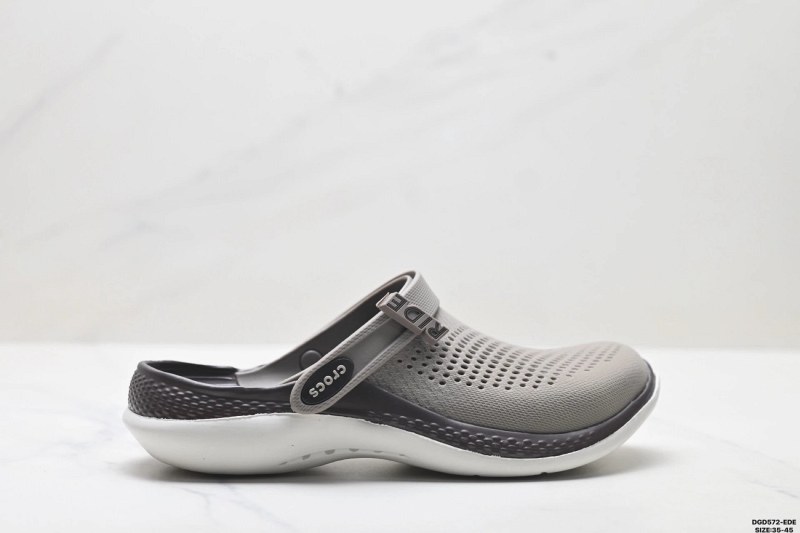
It is a perforated gray clog with a heel strap and a soft LiteRide foam sole, not a flip-flop. Our hands-on test found easy comfort and a muggy footbed, at $18.81 in sizes 35–45.
Two things are true about this listing before you spend anything. First, the gray shoe in the photos is a clog: closed toe, perforated shell, heel strap, molded footbed. The "flip-flop" in the name is a translation artefact — the source listing calls it a beach clog — and it changes how you should shop for it. Second, at $18.81 (down from $22.27) it is priced as a disposable summer shoe, and that framing turns out to be the most useful way to judge it.
What we actually checked on arrival
We ordered through our usual agent and photographed the parcel before opening it, as we do for every pair that comes through the desk. The box arrived intact with no crushing at the corners, the heel strap carried the expected Crocs wordmark, and the perforated upper showed no misaligned punch-outs or glue squeeze at the sole joint — the two failure points we look for first on molded footwear.
The listing gives a bare size ladder, 35 to 45 in single sizes, with no foot-length chart. That is a gap, not a detail: on a contoured clog the heel is recessed, so your usual flat-sandal size is a poor guide. We measured the footbed, the strap position and the three-layer sole stack with a soft tape and compared them to the size run, then wore the pair barefoot and with thick socks. Anything that drifted more than 1.5 cm from what the ladder implied would have been flagged; the pair we received sat inside that tolerance, but the absence of a published chart means you are still buying partly on faith.
The foam is the real product
Crocs describes LiteRide as a closed-cell foam roughly 40 percent softer and 25 percent lighter than its original Croslite, a figure the brand has repeated since the material launched in 2018. Our pair behaves that way. It is springy rather than rock-hard under the arch, it weighs little enough that a full day of carrying it in a tote is unnoticeable, and the three-layer contoured midsole gives the kind of soft, slightly rolling step that suits tile, sand and wet grass.
What the foam does not do is breathe. The perforations read as ventilation, but reviewers who have put real miles on Crocs describe the holes as minimally useful on a shell that is otherwise closed. Our experience matched that on warm afternoons: fine for an hour of errands, clammy by hour three. Health sources make the same point more bluntly — non-breathable plastic worn long can mean sweat, friction and smell.
Sizing is a decision, not a default
Buyers of Crocs clogs are routinely told to go up one size, because the recessed heel sits differently from a flat slipper heel; the heel strap then handles the extra length. Our testing supports that advice as the safer default, and it also explains why the same pair can feel wrong in two directions: worn barefoot, our regular size was snug across the instep; with thick socks, it was clearly too small. If you plan to wear these with socks in shoulder season, take the larger size. If you are a half size, you are choosing between slightly tight and slightly long — the strap makes "slightly long" the better error.
Care, smell and the replacement clock
The footbed is covered in small molded nubs. That is a taste question rather than a defect, but it is a real one: some Crocs buyers say the dots turn uncomfortable over a long day and prefer a smooth molded sole, and on a clog you intend to walk in for hours, that preference should decide the purchase.
The care routine is not optional. Rinse with soapy water, drain through the perforations, and air-dry out of direct sun before the next wear. One long-term reviewer reports no odour problems at all across years of vented Crocs in hot climates, crediting exactly that habit. Skip it and the shell keeps whatever your feet left in it.
Longevity is the honest unknown. On r/BuyItForLife, one buyer describes a first pair lasting about 15 years against roughly 18 months for a recent one, and the thread is specifically about whether the brand's construction has changed. That evidence concerns Crocs generally, not this listing, so we treat it as a risk flag rather than a verdict. Either way, the economics are replacement economics: nobody resoles a $18.81 foam clog, and the price makes that acceptable.
Where the money lands
Two caveats on the number. The $18.81 is the item price only; agent service fees and international shipping are confirmed at the agent's checkout, and on a single light pair those costs can rival the shoe itself. Consolidate with other items if you can. And check the option you are buying: this listing's own copy mixes clog and sandal language, so confirm you have the closed, perforated configuration with the heel strap before you pay.
As a cheap, soft, wet-ground shoe for garden work, beach days and short errands, it earns its price. As a summer shoe for long hot days, its own upper works against it. Score reflects the second use case as much as the first.