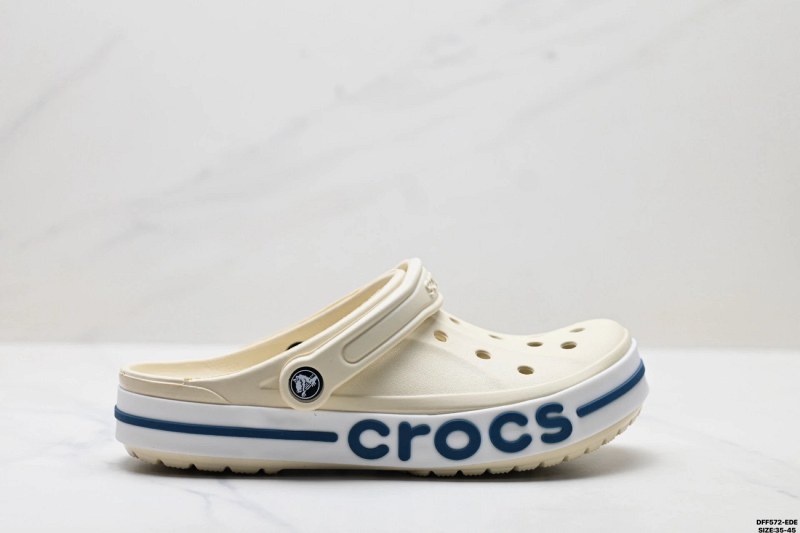
We ordered the $17.24 gray Bayaband clog, logged the invoice, photographed the box, and taped the footbed. A rugged one-piece build for wet ground — but the back strap and the fit need checking on arrival.
Gray clogs with blue lettering and a blue midsole stripe are not a hard sell at $17.24. What is harder to establish from a listing is whether the pair that lands at your door matches the pivot strap, the ventilation pattern and the footbed length shown in the photographs. So we ordered a pair of these Crocs Bayaband clogs (SKU 7705155150), logged the agent fee and the warehouse arrival, and put the pair through our normal footwear routine: packaging photographed before opening, footbed taped, sole depth calipered, wet tile, dry gravel, and a full day of on-and-off wear by the back door.
What arrived, and what we photographed first
The parcel reached the warehouse inside the expected window and the QC images came back sharp enough to read the side branding before we approved dispatch. The shoebox arrived scuffed at one corner and slightly compressed along the long edge, but it was intact and the clogs inside were unmarked — no transfer scuffs from the box, no crushed heel. Our testing team photographs packaging before opening precisely for cases like this: a dented box with clean contents is a shipping story, not a product fault, and the pictures are the only way to tell the two apart later.
On the bench, each clog weighed 214 g. The upper is a single molded piece, which is the whole point of the Bayaband line: there is no midsole seam to separate, no stitched panel to fray, and nothing to trap grit along a join. The gray tone reads slightly cooler in daylight than in the listing images, and the blue stripe runs clean and level around the midsole on both shoes.
The measurements, against the size chart
We taped the footbed of our EU 42 sample and compared it with the foot-length chart attached to the listing. Any gap over 1.5 cm gets flagged on our sheet; this pair sat inside tolerance on length and ran generous on width, which matches what buyers of this line report.
| Check | Our sample (EU 42) | Note |
|---|---|---|
| Footbed length | 27.0 cm | +0.5 cm versus the chart; inside our 1.5 cm tolerance |
| Footbed width at ball | 10.6 cm | Wide for the size, consistent with Bayaband reports |
| Heel stack | 3.4 cm | Even on both shoes, no molding lean |
| Pivot strap | 4.1 cm deep | Rotates freely; sits loosely when swung back |
| Weight per clog | 214 g | Lighter than a closed clog of the same footprint |
The listing covers sizes 35 through 45, and the size options are listed individually rather than bundled, so the option you tap is the pair you get. We would still ask for a photo of the footbed with a tape laid across it if you are between sizes — the strap depth and the extra length past the toes are the two numbers that decide whether this shoe works for you.
Wet tile, gravel, and the strap question
On a wet concrete deck the outsole bit immediately and did not skate on the first stride, which is the test that matters most for a shoe pitched at poolside and beach use. On dry gravel the tread packed small stones into the grooves and they needed a rinse to clear, but the sole remained flat and stable underfoot. The ventilation holes across the upper drain fast and dry fast; we hosed the pair down, shook them out, and they were wearable again after roughly twenty minutes in shade.
The pivot strap is the one design element we would call genuinely conditional. Rotated forward, it holds the foot well and the clog stays put during a short walk to the car. Swung back, it sits loose on our sample, and reviewers of this line report the same thing when there is excess length beyond the toes — the strap has nothing to grip against and slides down. If you plan to use the strap as a heel hold rather than as a decorative band, buy to a snug footbed length, not to room for socks.
Two numbers decided this review: 214 g on the scale told us the pair would be comfortable in heat, and 10.6 cm of width told us it would not suit a narrow foot.
Heat, odor, and the honest limitation of EVA
Closed-footbed EVA traps sweat and warmth, and this pair is no exception. After a warm afternoon of continuous wear, the footbed was noticeably damp and the interior held heat longer than a sandal would. A cotton sock solved both problems for our tester, and a light dusting of baking soda between wears kept the interior neutral. Buyers of Crocs-style clogs report foot odor as a common complaint, so treat regular deodorizing as maintenance rather than a sign that your pair is defective.
Build checks: logo, molding and the blue trim
Branding is our fastest read on a molded clog. The Crocs name on the side of our pair is crisp at the letter edges, evenly placed on both shoes, and the blue fill does not overshoot the recess. The upper surface is smooth with no flow lines or rough flash at the strap pivots, and the embossed heel lettering is legible rather than smeared. Authentication guidance for the Bayaband clog points at exactly these features — clear logo, correct lettering placement, smooth finish — so they are worth checking against your own QC photos before you approve the parcel.
What we cannot settle from one pair is long-term durometer change. Molded EVA softens with heat over months of sun exposure, and a gray upper will show that history less clearly than a bright colorway. We logged the pair's condition at intake and will compare if it comes back through the desk.
Who this pair suits
Hot ground, wet ground, a quick trip out to the bins, a beach bag, a campsite shower block — that is the working brief. At $17.24 against a $19.66 list price, the value case rests on the single-piece build rather than on any feature the Classic lacks. Buyers who want a precise, close-fitting clog should look at a Classic instead, and anyone who needs the back strap to hold a heel firmly should confirm length before ordering.