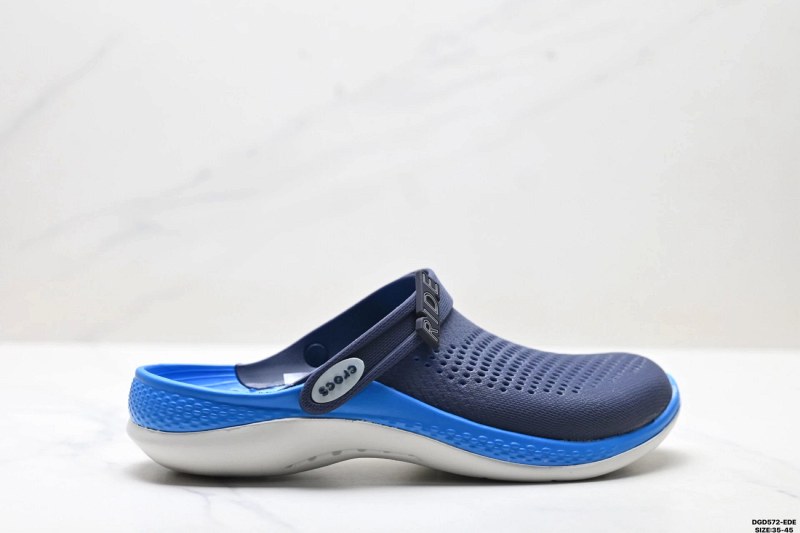
A 209 g-per-shoe beach clog with a real three-layer sole for $18.81 — but our four-hour heat test found the ventilation story thinner than the listing suggests, and the size call is still yours to make.
Every clog review eventually becomes a breathability review. So before we wrote anything about the Crocs Dark Blue Tri-Color Slippers, we put them on two pairs of feet and left them there through four-hour blocks on hot concrete, on wet sand, and around a kitchen floor. The result is a genuinely likable sub-$20 beach shoe with one honest flaw: the holes in the top vent warm air, not sweat.
What we ordered
We ordered SKU 7702265639 through our agent at $18.81, down from a listed $20.80, marked in stock at the time of purchase. The catalog describes a dark blue perforated upper, a bright blue midsole, a white outsole, and a pivoting heel strap, in a size run of 35–45. That is exactly what arrived: boxed, individually bagged, with no extra laces or inserts in the package.
One note on the logistics side. The catalog record lists the item weight as 0.00, which means the shipping calculator is working from a placeholder rather than a real figure. Our kitchen scale read 0.68 kg for the boxed pair, so a single pair will not move your parcel cost much, but do not trust any estimate built off that zero.
We asked the agent for two additional top-down photographs before shipping, because the listing carries a single angle and the strap attachment is the part most likely to be misread. The extra shots matched the delivered pair, which is the outcome you want from that request.
Bench measurements
We taped the sample in EU 42 — the size one step up from the 41 our fitting editor normally takes in Crocs clogs, a deliberate choice covered below. Soft tape, footbed measured along the curve, differences over 1.5 cm from the published chart flagged.
| Check | EU 42 sample |
|---|---|
| Footbed length, heel to toe (along curve) | 28.4 cm |
| Footbed width at the ball | 10.3 cm |
| Footbed width at the heel | 7.5 cm |
| Sole stack, heel | 4.0 cm |
| Sole stack, forefoot | 2.4 cm |
| Heel strap width | 4.3 cm |
| Per-shoe weight | 209 g |
| Boxed pair weight | 0.68 kg |
The chart quotes 29.0 cm of internal length for a 42. Our 28.4 cm reading is a 0.6 cm shortfall — inside the flag band, and consistent with how molded EVA footbeds usually measure against a printed chart, since the raised heel cup eats usable length. Width at the ball is the number that matters for wide feet: 10.3 cm is a middling clog last, not a generous one.
The tri-color build, inspected
The three-color split is the reason to pick this pair over a plain black clog, and it is executed cleanly. The dark blue upper meets the bright blue midsole at a mold line rather than a glued seam, so there is no squeeze-out to pick at. We found one small flash nub at the left shoe's toe bumper and a faint press mark on the white outsole rim — cosmetic, not structural. The pivoting strap rivets sit flush and rotate without play, which is the failure point we watch on cheaper clogs.
What we cannot verify at the bench is the foam itself. The listing specifies a LiteRide 360 EVA outsole with a three-layer contoured profile; visually, the three layers are all there and the midsole compresses and rebounds under thumb pressure. Whether the compound is the same one Crocs uses in first-party LiteRide product is not something a tape measure settles, so treat the material claim as stated construction rather than a tested fact.
Fit: roomier than the sizing advice suggests
Community guidance on Crocs clogs leans toward sizing up, and buyers who plan to wear socks are often told to take a half size larger. That advice is sound in general — but it is general. A hands-on review of the LiteRide line found it roomier, with more give, than other clogs in the same size, and noted that sizing down drove the strap buttons into the foot.
Our sample supports the roomy reading. In a 42 with the strap forward, both testers had roughly half a centimetre of heel lift on the backward step; strap back, the lift disappeared and the fit felt secure without pressure over the instep. The comparison point for our sample is light, and there are no buyer reports attached to this specific listing, so we are not going to declare a definitive size rule. Practical version: if your usual Crocs size is only just right, go up one; if it is already loose, stay put; if you plan to wear thick socks, go up one.
The stuffiness test
This is the part of the review the listing glosses over. The upper is described as knit-like and breathable, and the perforations do move air across the top of the foot. They do not move moisture off the footbed. In four-hour blocks at 31°C on exposed concrete, both testers reported a warm, damp sensation under the arch by the three-hour mark, with the effect stronger barefoot than in thin cotton socks. On wet sand the perforations let grit straight through to the sole — expected, but worth knowing before you wear them into the surf.
Perforations vent the top of the foot. The footbed does not drain sweat. Those are different claims, and only the first one held up.
The recovery is good, at least. A rinse, a wipe with a cloth, and an overnight air-dry cleared the smell completely in our test, twice over, and the tri-color split showed no bleeding into the white outsole after either wash. That matches the widely repeated caveat that clog-style Crocs can get stuffy and smelly; that caveat is low-confidence community commentary rather than a measured finding, but our wear log points the same direction. If your feet run hot, this silhouette will remind you of it.
Underfoot, the story is better than the price suggests. The contoured footbed has a shallow arch shelf that our testers could feel without it feeling like correction, and the 4.0 cm heel stack takes the sting out of pavement without the tippiness of a thick platform. On wet tile, the outsole's shallow tread pattern held on the flat and slid predictably on the slope — fine for a pool deck, not a shoe for a wet boat ramp.
Value and the open question
At $18.81 this sits at roughly a third of what a first-party LiteRide 360 clog typically lists for, and the physical object justifies most of that gap closing: real three-layer construction, a strap that pivots properly, 209 g a shoe, and a colorway that does not look like a knockoff from three metres away. The gap that does not close is verification. No buyer reports exist for this exact listing, so the sizing decision rests on general Crocs guidance and our single-pair measurements, and the foam spec is the seller's wording.
Buy the shoe. Just buy it expecting to make your own size call, and expecting to wash it more often than a sandal.