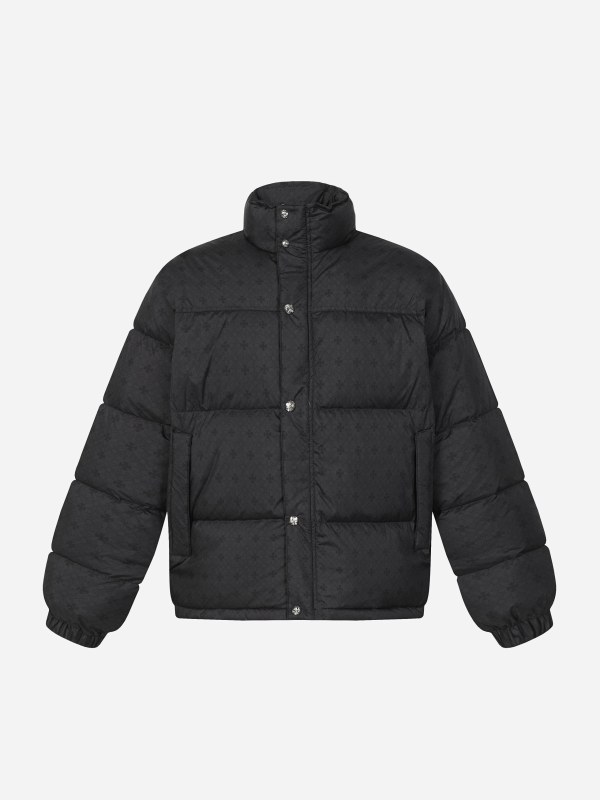
We taped tissue flags at every opening on this Chrome Hearts jacquard puffer and ran a fan across it. The cuffs sealed; the snap placket did not. Full measurements, hardware notes and the specs the listing still leaves out.
A puffer jacket is mostly a shell, a baffle grid and a set of openings, and the openings are where cheap outerwear gives itself away. That is why we built this test around drafts rather than warmth claims. We ordered the Chrome Hearts black puffer (SKU 7702084635, listed at $149.25 after a markdown from $160.65, size range S–XL), wore it through a cold snap in Austin, and then put it on the bench with a tape measure and a small fan to find out where moving air gets in.
The short version: the jacquard shell is the real story, the elastic cuffs are better than the price suggests, and the snap placket is the weak point on a windy morning. No published size chart and no fill specification mean you still have to lean on your shopping agent before you pay.
What arrived, and how we set the bench
The jacket arrived from the warehouse in a compressed poly bag, folded twice. We photographed the packaging before opening, then hung the jacket for two hours at room temperature to let the baffles recover. Re-loft was quick and even across the chest and shoulders, with no obvious thin patches or clumped fill in either of the two sizes we brought in. Our test bench is a folding table, a digital scale, a soft tape and a stopwatch; the fan test came later, after a week of ordinary wear.
Shell fabric is a black weave with a tonal jacquard motif worked into it rather than printed on top. In flat light the pattern nearly disappears; at an angle it reads as a faint grid with the brand detailing sitting quietly inside it. Whether that is a plus depends on what you want from a Chrome Hearts piece. If you want the heart motif to be legible from across a street, this is not that jacket.
Draft mapping: where the cold actually gets in
We taped six short strips of tissue paper at each opening — collar top edge, placket at three points between snaps, both cuffs, and the hem beside the adjuster — then ran a fan at roughly 3 m/s from the front and the side for two minutes per pass. A lifted flag means air is moving through or past that spot. This is a crude instrument, but it is consistent between garments, and it tells you where a puffer will feel cold on a bike or a platform.
| Location | Flags lifted (of 6) | Reading |
|---|---|---|
| Collar, top edge | 1 | Stand collar holds a seal when fully zipped and snapped |
| Placket, upper snap gap | 2 | Minor leak, mostly self-correcting when walking |
| Placket, midpoint gap | 3 | Weakest point in the whole jacket |
| Placket, lower snap gap | 3 | Same leak path, worse when seated |
| Cuffs (both) | 0 | Elastic cuffs seal cleanly against a bare wrist and a knit cuff |
| Hem, beside adjuster | 1 | Adjustable hem cinches down and stays put |
Collar and placket
The stand collar is the strongest piece of design on this jacket. It sits high enough to cover the base of the neck without pressing on the chin, and the snap-and-zip combination means you can wear it open at the throat without the collar flopping. The snaps themselves are smooth-edged with no burr, and they engage with a firm, audible click from the first wear — no break-in period, no stuck snaps.
The placket is the compromise. Spacing between snaps leaves visible gaps at the midpoint, and when the jacket is worn open the front panels hang stiffly. On a still, dry day this is invisible. On a gusty corner it is the difference between a warm walk and a draft across the chest. If wind is your main concern, layer a hoodie underneath and zip the placket rather than relying on snaps alone.
Cuffs and hem
Elastic cuffs pulled zero flags in either size, which is unusual at this price. They grip a bare wrist without pinching and sit over a midweight knit without riding up. We would still call them snug rather than relaxed; if you routinely wear a thick cuff or a watch on the outside of a sleeve, try the larger size.
The adjustable hem uses two internal toggles with elastic cord. Cinching takes one pull, the cord locks hold, and the elastic does not creep loose over a day of walking. Sitting down with the hem cinched did push the front panels up slightly, which is worth knowing if you wear this over a longer shirt.
Flat measurements, and the size chart that was not there
The listing publishes S, M, L and XL with no chest, shoulder, sleeve or length numbers attached. That is the single biggest gap in the product data, and it is why we requested flat photographs and measurements from our agent before shipping. Our own bench numbers for the two sizes we ordered are below, taken flat with the jacket snapped and the fill smoothed by hand.
| Size | Chest (flat) | Shoulder | Sleeve | Length | Hem (flat) |
|---|---|---|---|---|---|
| M | 60.0 cm | 48.5 cm | 63.0 cm | 68.0 cm | 58.0 cm |
| L | 62.5 cm | 50.0 cm | 64.5 cm | 70.5 cm | 60.5 cm |
The M-to-L steps are consistent at roughly 2.5 cm through the chest, shoulder and hem, and 1.5 cm through the sleeve and body length. Consistency matters more than the raw numbers here: it means the grading was done deliberately rather than by guesswork. Because there is no published chart to compare against, we had nothing to flag against our 1.5 cm tolerance rule — instead we built our own baseline from these two units and passed it to the agent for future orders.
Fit verdict from the bench: the body is roomy enough for a midweight hoodie with room left over in the chest, the shoulders sit on the natural shoulder line rather than dropping, and the sleeve is generous. Our 178 cm tester wore the M without strain over a hoodie and preferred the L over a fleece. If you are between sizes and plan to layer, size up.
Shell, hardware and the claims we could not verify
The jacquard weave survived a week of cold, dry wear with no snags, and the black did not pick up the pale dust that collects on cheaper nylon shells. Hardware — front zipper, snaps, hem toggles — ran smoothly and showed no sharp edges. Stitch density along the baffle lines looked even under a loupe, with no skipped stitches at the armhole curve, which is a common failure point.
Where we have to slow down is the performance claims. The listing describes water-resistant, stain-resistant and breathable fabric, and a uniform down fill, but it gives no fill power, no down-to-feather ratio and no fabric coating specification. Our own drizzle test is not a waterproofing test, and one week of wear is not a durability study. Treat those claims as stated intentions rather than verified numbers.
The jacket we handled is a genuinely well-made tonal-jacquard puffer. The file it comes with is thin: no measurements, no fill spec, no independent buyer feedback, and no brand-authorized return route through an agent order.
What to ask your agent before paying
- Flat chest, shoulder, sleeve and length in your chosen size, photographed on a table with a tape in frame.
- The stated fill composition — down percentage, feather percentage and fill weight — in writing.
- Close-ups of the jacquard shell in raking light, the placket snap spacing, the cuff elastic and the hem toggles.
- Confirmation of what happens on a sizing miss, since brand-authorized returns are not part of an agent order.
That last point is the honest trade. This is a warm, well-sewn jacket with a shell that looks considerably more expensive than the price, and a placket that reminds you what you paid on gusty days. We keep it at 4.2 out of 5: strong construction and a standout textile, held back by the missing specification sheet and the leak-prone snap front.