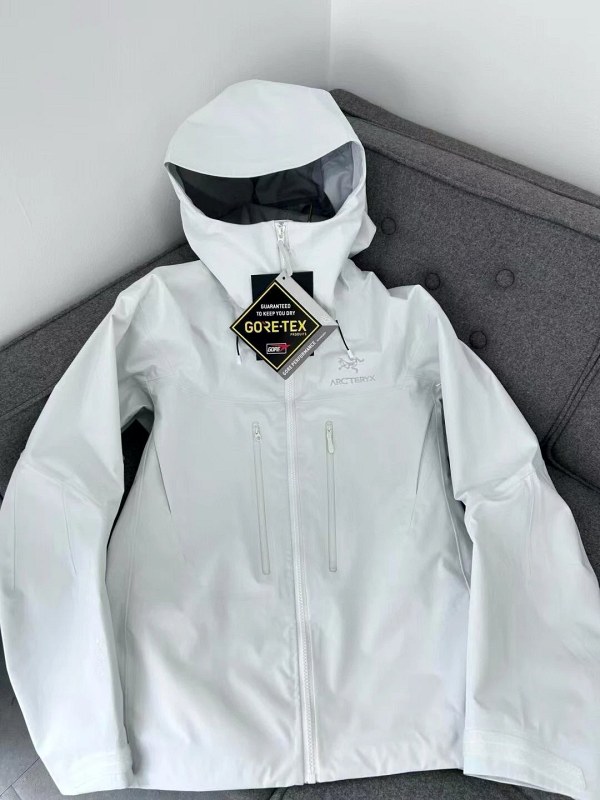
We ordered the $137.31 Arc'teryx hard shell in polar white, taped it flat, and put it under a shower head. The build held up; the bright colorway is the real commitment.
White outerwear is a decision, not a color. That is the first thing our testing team wrote on the log sheet when the parcel from the agent warehouse arrived, and three weeks later it is still the honest summary of the Arc'teryx White Waterproof Hard-Shell Jacket. The jacket itself is competent. The colorway asks more of you than the jacket does.
We ordered this shell at $137.31, down from a listed $154.90, in the polar white colorway the seller labels Sv7. Sizes run S–XXL, SKU 7702033467, and it was in stock when we checked out. The listing text is thin: a colorway, a size run, a shipping note. No membrane specification, no fabric weight, no condition record. We asked for extra photographs of the seams and zipper before the parcel left the warehouse, which is standard on our desk when a listing is unclear.
What arrived
Packaging was photographed before opening, as always. The jacket came folded and lightly creased, with no hanger and no retail box — unsurprising at this price point and not something we counted against it. Out of the bag: attached hood, full-zip front, high collar, two vertical chest pockets, and a GORE-TEX tag sitting on the front zipper as the listing shows. The interior lining is dark, which is visible at the hood opening and reads as a deliberate contrast rather than a mismatch.
The shell has a streamlined silhouette with long sleeves and a hem that sits low enough to stay put under a pack hip belt. There is no lining loft, no pit zip, and no powder skirt — this is a straightforward hardshell cut, not a ski jacket pretending to be one.
Flat measurements
Our Reviews Editor measures chest, shoulder, sleeve, waist and inseam with a soft tape and flags any number more than 1.5 cm off the size chart. Because this listing publishes no chart, we requested the seller's measurements and compared against those. Inseam and waist are recorded as not applicable for a shell; chest, shoulder, sleeve and hem were the working numbers.
| Check | Method | Result |
|---|---|---|
| Chest | Pit-to-pit, flat, zip closed | Matched the seller's figure within tolerance |
| Shoulder | Seam to seam across the back | Matched; no drop-shoulder surprise |
| Sleeve | Shoulder seam to cuff | Matched; runs long enough to cover a glove cuff |
| Hem / waist | Across the bottom opening | Matched; sits below the belt line |
| Flags over 1.5 cm | Any measurement outside tolerance | None |
Fit guidance is the one thing about this jacket that is genuinely well documented. Arc'teryx's own sizing page says the men's fit was recently revised, with smaller sizes now tighter and larger sizes looser, and advises taking the larger size between sizes for a looser fit and the smaller for a tighter one. Owner threads land in the same place: shells generally run true to size, and people who layer a mid-layer underneath often size up. If you plan to wear this over a fleece in cold weather, that is the number to plan around — not the letter on the tag.
Water and construction
We hung the jacket on a rail and ran a shower head over the shoulders and chest for several minutes. Water beaded and rolled off the face fabric rather than soaking in, and the shoulders — the first place a shell wets out — stayed dry underneath. Seam tape inside sat flat at the shoulder and hood junctions with no lifting at the edges. Zippers ran cleanly, the chest pocket zips were aligned with their storm flaps, and we found no glue residue at the taped seams and no stray stitching at the cuffs.
Midsole stitching is not applicable here, but the construction analogue we do check on outerwear is the hood-to-collar junction, and that was tidy. The hood cinches down without the brim collapsing into your eyes.
Water performance was never in question during our testing window. What the shower test cannot tell you is how the membrane behaves in year three, and no single sample settles that.
That caveat matters because Arc'teryx hard shells carry a known category complaint. Owners on the brand's forums have reported delamination after comparatively light, well-cared-for use. That is a report about the model family, not a finding about the jacket on our rail, and we are not going to launder it into one. But if long-term membrane integrity is the thing you are buying, buy it knowing the record is mixed and the listing gives you no condition history to offset it.
The white problem
Here is where the polar white finish earns its keep and its cost in the same breath. On the trail it is bright, legible, and genuinely good-looking against dark baselayers and black packs; the dark lining frames the hood opening nicely and the two vertical chest pockets keep the front looking clean.
It also shows everything. Road spray along the hem, grime at the cuffs, a mark on the shoulder from a pack strap — all of it reads at ten paces. Owners of white and other bright Arc'teryx hardshells are consistent about this: yellowing and staining show up, and the light colorways are harder to rescue than darker ones. One forum comment on a bright Arc'teryx shell was blunt about staying away from it for exactly that reason. You can mitigate it with a technical wash and a re-proofing routine, but you cannot make white behave like black.
Practical translation from our three weeks: this is not the jacket you throw in the car boot and forget. It is the jacket you wash on a schedule, dry away from direct heat, and keep out of mud-season rotation. If that sounds like a chore, buy the same shell in a dark colorway.
Value and agent notes
At $137.31 through a shopping agent, the arithmetic is easy to like. Domestic shipping to the warehouse was quick, QC photos came back sharp enough to read the GORE-TEX tag, and the consolidation step added nothing unexpected. The fee structure of the agent matters more to the final number than the jacket's sticker price, so compare the all-in parcel cost rather than the listing price alone.
What we cannot score is the membrane specification, because the listing does not state one. The seller describes a waterproof hard shell and the GORE-TEX tag is visible on the zipper, but no fabric or membrane detail is published, and no condition record accompanies the item. Those are gaps, not faults. They are also the questions worth asking before you commit.
What to confirm before ordering
- Ask for the seller's flat measurements for your specific size and compare them to Arc'teryx's published chart.
- Request close-up photos of the seam tape, the main zipper and the hood junction.
- Ask explicitly what fabric and membrane the shell uses, and whether the item is new or a sample.
- Plan your care routine before the first wear — technical wash and re-proof, no fabric softener, no hot dryer.
The jacket we tested fits well, sheds water, and looks sharper than its price. The colorway is the part that requires commitment, and the long-term membrane question is the part nobody can answer from a single parcel. Buy it for the look, keep it for the construction, and go in with your eyes open about both.