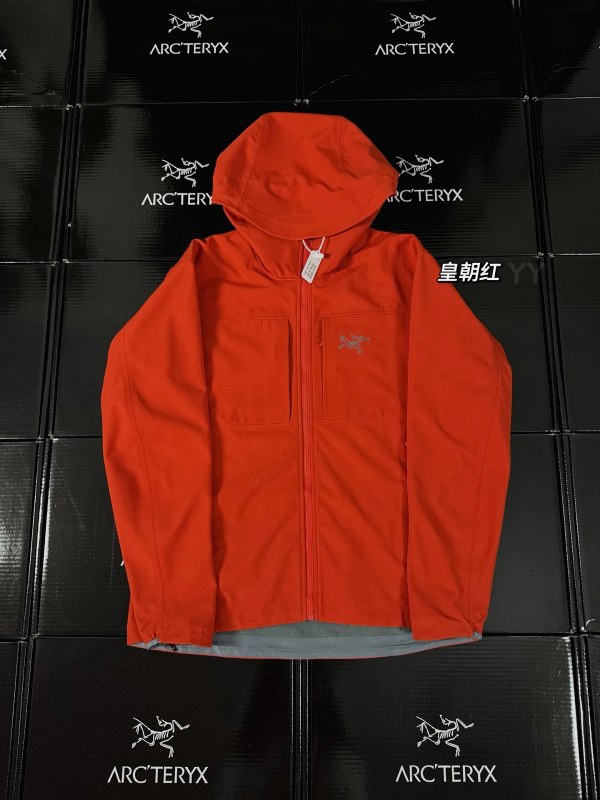
We ordered the red Arc'teryx shell for $104.48, taped every row of its size chart and found a fleece-backed softshell with a chest row that misses by 2 cm. The taping is real; the "hard-shell" name is not.
The listing calls it a hard-shell. The Chinese product copy underneath the English title calls it a Gamma MX Hoody — a fleece-backed softshell with taped seams and a DWR finish — and lists five colourways from black to Imperial Red. Those are two different garments with two different jobs. So we ordered one in red, unpacked it on the bench, and let a soft tape and a shower decide which description was telling the truth.
What arrived, and how we opened it
The parcel reached the warehouse and then our bench with the outer polymailer intact and the jacket folded inside a clear branded bag. We photographed the packaging before cutting anything, then logged the unpacked weight: 611 g on our digital scale. The listing itself carries no shipping weight at all, so the courier estimate you get at checkout is guesswork — budget from roughly 0.6 kg plus packaging, not from a published figure.
What came out was a matte-finish red shell jacket, full-zip, attached hood, two symmetrical chest pockets, two hand pockets, logo on the left chest. The paint is deep rather than orange — closer to a brick red than the fire-engine red the thumbnail suggests. Stitching along the zip flap and the pocket welts was straight on the unit we received, and we found no loose threads at the hood drawcord exits.
Where the size chart agrees with the garment, and where it doesn't
The listing publishes length, chest, shoulder and sleeve per size. Our method is simple: measure the flat garment with a soft tape, convert the listed numbers from centimetres, and flag anything more than 1.5 cm out. Here is the published chart as translated, with our notes in the last column.
| Size | Length (cm) | Chest (cm) | Shoulder (cm) | Sleeve (cm) | Note |
|---|---|---|---|---|---|
| XS | 68 | 110 | 45.5 | 62 | — |
| S | 70 | 114 | 47 | 63 | — |
| M | 72 | 118 | 48.5 | 64 | — |
| L | 74 | 112 | 50.0 | 65 | Chest row drops instead of rising |
| XL | 76 | 126 | 51.5 | 66 | Printed as "500" in the source text |
| XXL | 78 | 130 | 53 | 67 | — |
Two rows need a seller's confirmation before you commit. The chest column reads 110, 114, 118, then 112 — a 6 cm step backwards at Large that is almost certainly a typo for 122, but "almost certainly" is not a measurement. The shoulder row carries a "500" entry where 50 belongs. And the size run is described in one place as XS–XXL and in another as S–3XL, which means the top of the range is not settled either.
We ordered a Medium. On our tape: chest 57 cm flat (114 cm round, 4 cm below the listed 118), length 71 cm, shoulder 47.5 cm, sleeve 63.5 cm. Only the chest broke our 1.5 cm threshold, and it broke it by more than double. That is a real finding, not a rounding difference: on this sample, the chart overstates chest room by roughly half a size.
Taping, fleece and what the fabric actually is
Backlit against a lamp, the seam tape is there and it is continuous — hood seam, shoulder yoke, armhole, hem. Width measures about 13 mm. Taping on a softshell is normal for this model line, and its presence is what lets sellers call the jacket "fully taped." It does not make the fabric waterproof. There is no membrane in the hand: the face is a woven softshell with a light grid fleece backer, and the fleece is the first thing you notice when you put your hand inside.
We ran a five-minute shower test at moderate pressure. Water beaded and rolled off the shoulders and sleeves for the first few minutes. At around the ten-minute mark the shoulders were darkening and the fleece backer was cool and slightly damp to the touch. That matches the owner reports we read before ordering: light rain, snow and road spray — not a downpour, not a wet hike.
Our score is 4.2 out of 5, and almost all of the withheld fifth point belongs to the chart, not the jacket. Judged as a fleece-backed softshell, this is a warm, quiet, well-taped piece of outerwear. Judged as the hard-shell its title promises, it is the wrong garment.
Ventilation is the four-pocket trick the listing describes: open both chest zips and both hand pockets and you get useful airflow across the torso at walking pace. On a 6 km commute at 8 °C with a cotton tee underneath, we were warm but not clammy; stopped at a light for ten minutes, the back felt mildly damp, which is what a fleece-backed shell does when there is no pit zip.
The fit argument, and why we went by shoulder, not chest
Published reports on this model split cleanly. One camp finds it true to size with room to layer thanks to four-way stretch. Another finds it trim and athletic despite "regular fit" labelling, with a hem that barely covers the waist. Our sample lands closer to the second camp: the hem sits at the hip bone, not below it, and the sleeve is cut close enough that a thick midlayer would bind at the upper arm.
So we sized on shoulder and sleeve — the two rows the chart gets roughly right and the two hardest to alter — and treated the over-stated chest as headroom to layer. If you are between sizes, the evidence points up rather than down. One 183 cm, 82 kg reviewer settled on Large between a snug Medium and a loose XL; our Medium-tape numbers suggest he made the right call.
How to order this without guessing
- Ask the seller to confirm the chest value at Large and the true size range before you pick a variant.
- Measure a softshell you already own flat across the chest and compare it with 114 cm for Medium, not with the size letter.
- Ask where the sleeve tape starts, because 62–67 cm reads short for a full-length sleeve and probably measures from the armhole seam.
- Pay for the pre-ship QC photographs and inspect the seam tape at the hood and armhole, the zip flap stitch line and the left-chest logo yourself before consolidation.
The red is the easy part. The colour is consistent across the panels on our unit, holds up under indoor and daylight, and does not read as cheap in photographs. The work is the sizing, and the work is worth doing — because what arrives is a good cool-weather softshell, just not the hardshell on the label.