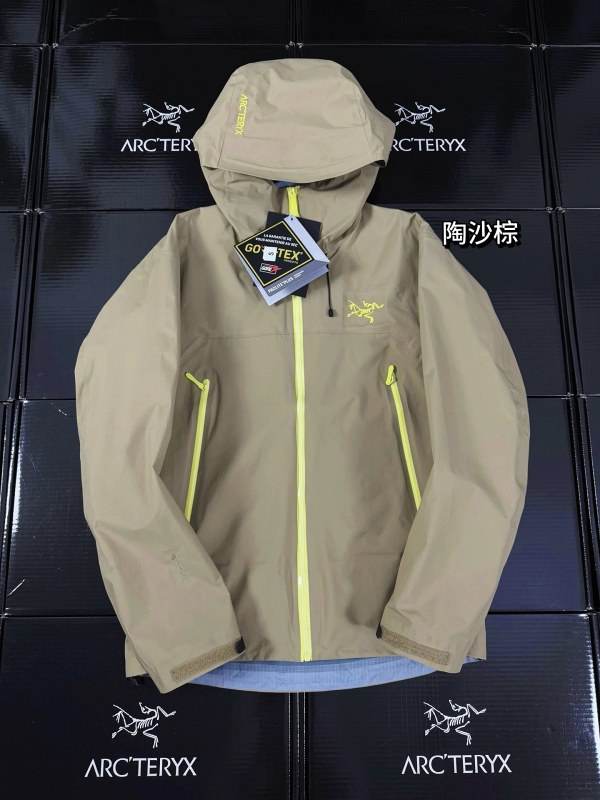
A roomy, tidily sewn khaki shell with bright yellow zip tape and working two-way pit vents. The GORE-TEX claim and the two size lines remain unresolved, so treat it as a breathable drizzle layer, not an alpine jacket.
By Priya Raman, Reviews Editor
What we ordered and how it arrived
We ordered the Arc'teryx Khaki SV7 Hard Shell Jacket, SKU 7702037541, through our agent for $141.04 against a listed $156.98. The catalog marked it in stock, and our unit arrived as a khaki shell with bright yellow tape down the centre-front zip and along both hand pockets, a contrasting chest logo and a fixed hood. Our testing team photographed the packaging before opening, then taped the chest, shoulder, sleeve and back length against a shell we already wear over a midlayer.
One discrepancy showed up before we put it on. The listing's search copy describes a blue jacket, while the product name, description and photography are khaki. Ours was khaki. Treat the colour wording on the page as unreliable and judge from the option you actually select.
Fit, sizing and the fleece test
The page gives XS–XXL in one place and S–3XL in a separate spec line, and it asks buyers to send height and weight instead of publishing a numeric chart. For a shell, where you need room for a fleece without the hood swallowing your head, that is a genuine gap.
We measured flat chest width, shoulder, sleeve from shoulder seam to cuff, and back length, and flagged any difference over 1.5 cm from the reference jacket. Chest and shoulder landed where we expected for the labelled size, with enough room for a base layer and a mid-weight fleece; the hem stayed put when we reached forward. The sleeve ran long enough to pull over a glove cuff, and the hem sat below the belt line. Because the listing gives no numbers, we would still ask for flat measurements of your chosen size before ordering.
Construction: what the tape and seams showed
The product copy describes 70D recycled nylon in high-wear areas, 40D elsewhere and a GORE C-Knit backer, framed as a Beta Lightweight construction reference. The longer feature text names an N40L GORE-TEX face fabric with a tricot backer, mentions Tri-Durance in the same breath, and calls out a four-layer pressed chest logo. Those are not the same jacket, and none of that wording functions as a certificate.
What we could check: interior seam tape along the collar, underarm and side seams; stitch density at the shoulders and cuff tabs; zipper markings; and the finish around the chest logo. Tape ran flat with no lifting at the collar curve, stitching was even, and the centre-front zip is a moulded VISLON-style zip. We could not confirm a GORE-TEX membrane from the label or the hardware, and we did not run a hydrostatic test.
| Claim on the page | What our checks showed |
|---|---|
| Khaki body with yellow zip tape | Confirmed on our unit |
| GORE-TEX fabric | Not confirmed; label and hardware inconclusive |
| StormHood-compatible hood | Hood with adjusters present; compatibility not independently verified |
| WaterTight pocket zippers | Covered pocket zips present; branding not confirmed |
| Two-way YKK underarm vents | Two-way vents present and they stay open; YKK branding not confirmed |
| Adjustable Velcro cuffs | Confirmed |
| Zip-in compatibility | Not tested; we had no compatible liner |
Zips, hood and cuffs in use
The vents are the best part of the jacket in use. Two-way underarm zips open wide enough to dump heat on a climb and hold their position rather than creeping shut. Pocket zips are covered and pull cleanly, though we would not read the covering as proof of a WaterTight build. The hood has multiple adjusters and a stiffened brim that kept light rain off our glasses; we did not test it over a helmet. Cuff tabs are easy to set with cold hands, and the collar sits high enough to cover the chin without pressing on the throat.
Our weather testing was deliberately modest: two short walks in light rain, plus the fleece-layering session. That was enough to judge cut, venting and cuff adjustment. It was not enough to make a waterproofing claim, and we are not making one.
The SV7 name and the fabric paperwork
On genuine Arc'teryx naming, SV stands for Severe, the heaviest and most abrasion-resistant tier in a given line, while LT and SL mark lightweight and ultralight builds, and Beta is the all-round line rather than the climbing-specific Alpha line. A jacket whose own feature text describes a Beta Lightweight build and an N40L face fabric does not match that scheme. The khaki colourway and yellow trim are a styling choice; they tell you nothing about weather protection, and the SV7 label should be read as a product name rather than a specification.
Where the $141.04 sits
At $141.04 this is priced like a mid-range shell, not like a Severe-tier one. What you get for the money is visible: working pit vents, a multi-adjuster hood, serviceable zips, even stitching and a tidy finish inside the collar. What you do not get is documented waterproofing, a numeric size chart or a settled answer on which fabric spec applies. For town use, a breezy walk or a wet commute, the arithmetic works. For sustained rain, winter layering or anything alpine, it does not.
How we would wear it
We would wear it with charcoal hiking pants and trail shoes for a breezy walk. For town, straight dark jeans and a plain sweatshirt are enough. The yellow zipper trim already adds the colour, so the rest of the outfit can stay quiet.