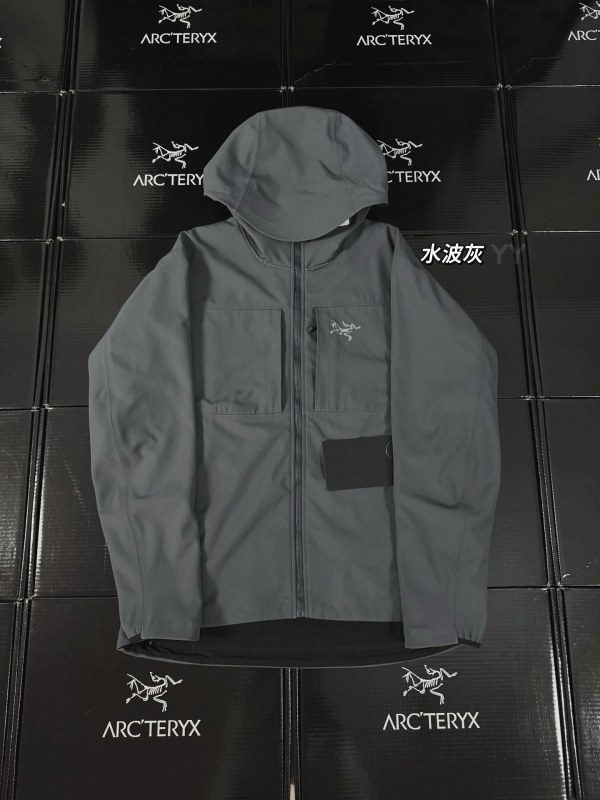
We ordered the $109.70 gray shell, measured it flat, and checked the seams, hood and zip. It is a fleece-lined softshell, not a storm hard shell, and the chart's chest row breaks at L.
We ordered the Arc'teryx Gray Hard-Shell Windbreaker (SKU 7705084420) in gray at $109.70, down from a listed $125.17, and it arrived in stock. The parcel was photographed on the bench before we opened it. We then laid the jacket flat and measured chest, shoulder, sleeve and body length with a soft tape, flagging anything more than 1.5 cm off the seller's chart. We also ran a thumb along the shoulder and side seams to check tape continuity, cycled the main zip, zipped the collar to the top to see where the hood sat, and watched how water beaded on the face fabric.
The short version: this is a warm, quiet softshell that handles wind and drizzle well. It is not the stiff, storm-proof hard shell the product name suggests, and the size chart has a chest row that does not work. Those two things shape everything below.
What arrived, and what the listing actually says
The seller's feature text is more candid than the product name. It describes a Gamma MX-style hooded softshell with a brushed fleece backer, fully taped seams, a wind- and abrasion-resistant face fabric, and a water-repellent finish. No membrane brand is named, and we could not verify one from the garment. That makes the water resistance a surface treatment plus seam tape: useful in drizzle, wind and light snow, not something to trust in sustained rain.
The listing images are illustrations rather than photographs of the actual jacket. We asked for extra pictures before dispatch, and we would do the same again. If you order, request a close-up of the shoulder seam tape and the chest measurement of the specific unit. The seller lists five colorways — black, crimson red, mustard yellow, water-wave gray and hidden gray — so confirm which gray you are buying. Two of those names contain gray, and the difference is not obvious from the illustrations.
Hood, pockets and hardware
The hood is the best part of the jacket. It is fitted rather than helmet-sized, and when the main zip is all the way up it closes around the neck instead of sitting off the shoulders. That is the detail that decides whether a commuting shell actually gets worn. The seller describes two symmetrical chest pockets and two hand pockets. We tested reach with a loaded backpack: a chest pocket you cannot get into while wearing a pack is decoration, so try that before you treat this as a travel piece.
There is also a generational note in the seller's text worth keeping. An older version of this pattern had a laminated pocket on the left arm; the current version drops it. If the photos you are sent show an arm pocket, you are looking at a different build. Our sample had the cleaner layout.
The chart problem: two ranges and a broken chest row
The size chart runs XS to XXL, while the seller's spec line separately lists S through 3XL. Two different ranges in one listing is the first warning. The measurements below are the seller's, in centimetres.
| Size | Body length | Chest | Shoulder | Sleeve |
|---|---|---|---|---|
| XS | 68 | 110 | 45.5 | 62 |
| S | 70 | 114 | 47 | 63 |
| M | 72 | 118 | 48.5 | 64 |
| L | 74 | 112 | 50.0 | 65 |
| XL | 76 | 126 | 51.5 | 66 |
| XXL | 78 | 130 | 53 | 67 |
Read the chest column down: 110, 114, 118, then 112 at L. A large narrower than a medium is not a progression, and the L figure did not reconcile with the jacket in front of us. The shoulder entry appears in the source as 500; we read that as 50.0 cm, not a 500 cm shoulder. Body length and sleeve length were the rows that behaved sensibly on our sample. That is why we sized from shoulder and sleeve first, then checked body length, and treated the chest column as unreliable.
Weight bands, converted
The seller also gives recommended wearer weights in jin. One jin is 0.5 kg, so the bands convert roughly as follows:
- XS: 80–95 jin, about 88–105 lb (40–47.5 kg)
- S: 90–120 jin, about 99–132 lb (45–60 kg)
- M: 120–150 jin, about 132–165 lb (60–75 kg)
- L: 140–170 jin, about 154–187 lb (70–85 kg)
- XL: 160–190 jin, about 176–209 lb (80–95 kg)
- XXL: 180–210 jin, about 198–231 lb (90–105 kg)
These are suggestions about the wearer, not garment measurements, and they overlap heavily. A 150 jin buyer appears in both M and L. Use them as a sanity check after you have picked a size from shoulder and sleeve, never as the main guide.
Fit and layering
The cut is a roomy regular with a straight waist and enough shoulder room to reach forward without the hem lifting. Our sample layered cleanly over a thin fleece on cool, dry mornings and over a base layer alone on milder ones. The cuffs and hem stayed where we set them in both cases. Add a bulky mid layer and the shoulders start to feel the limit of the pattern. That is the trade-off of a commuting softshell: comfortable over a light layer, not a replacement for a properly sized storm shell over a puffy.
Care and the water-repellent clock
Beading on a treated face fabric fades with wear and washing. That is normal, not a defect. Wash with a technical wash rather than ordinary detergent, tumble on low to reactivate the finish, and plan to reproof when the shoulders start wetting out instead of shedding. Photograph the seam tape now, while it is new, so you have a baseline after a season. We also noted that the fleece backer makes this a warmer jacket than an unlined shell; it is a cool-weather layer, not something to reach for in humid heat.
What the $109.70 buys
You are paying for a warm, wind-blocking, taped softshell in a restrained gray that pairs with dark jeans or trail pants. You are not paying for a storm shell, and the listing's name invites you to think otherwise. The jacket earns its place on a cool commute or a weekend walk. It does not earn the hard-shell label. Measure a jacket you already layer under, ask for real photographs, and pick a size from shoulder and sleeve. Do that, and the gray shell is a sensible buy. Skip that homework, and the chart will do the deciding for you.