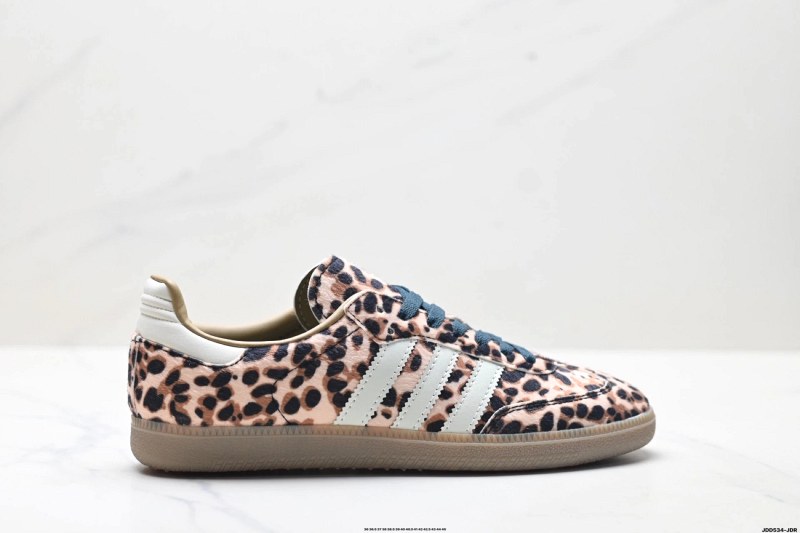
A $31.34 Samba-shaped shoe with an even leopard print, gum sole and white serrated stripes. We measured a EU 42 and traced the listing's style code to a different adidas Samba — here's what that changes before you order.
Leopard print has become an annual event on the Samba line. adidas has run the pattern across the silhouette repeatedly since early 2025 — women's pairs at $110, long-tongue versions at $120 — so a $31.34 catalog listing showing a spotted low-top with white serrated stripes, a white heel tab and a brown gum sole is worth a serious look rather than a shrug. We ordered a EU 42 through our agent, logged the fees, photographed the packaging before opening, and put the pair on the bench.
What arrived, and what we photographed
The parcel came through consolidation in a grey poly mailer taped at both seams. Inside, the shoebox had one crushed corner and a scuffed lid, but the pair sat square with paper stuffing and no creasing across the toe box. We photograph packaging before opening for exactly this reason: a dented box is a shipping story, not a product story, and it did not affect the shoes.
Out of the box, the pair matched the listing description line by line: dark spots on a light ground across the upper, white serrated three stripes on the side, a white heel tab, dark flat laces, and a brown gum sole on a low-profile Samba-style last. The listing copy in the supplier sheet calls it a Samba-series low-top with a football-trainer look, and the shape backs that up — long, flat, slightly pointed at the toe.
The bench numbers
We measure with a soft tape: insole heel-to-toe, width across the ball, heel stack and collar height. Anything beyond 1.5 cm from a published chart gets flagged.
| Check (EU 42 sample) | Measured | Note |
|---|---|---|
| Insole, heel to toe | 27.1 cm | No chart on the listing to compare against |
| Width across the ball | 10.1 cm | Snug on a wide foot |
| Heel stack | 2.2 cm | Forefoot roughly 1.4 cm |
| Weight per shoe | 372 g / 376 g | Listing publishes no weight |
With no insole chart on the page, our numbers are a reference point rather than a pass or fail. We did flag one grading quirk: the step from EU 43 to EU 44 added about 1.0 cm of insole length, while the 40-to-42 steps added about 0.6 cm each. If you sit between sizes at the top of the run, order the smaller of the two and let the upper do the work.
Two size charts in one listing
The listing contradicts itself on sizing. The title line reads 36 through 45 with half sizes included; the spec line reads 35 through 45 in whole sizes only. The catalog description says 35 to 45. Three statements, two of them mutually exclusive. If you want a half size, get your agent to confirm stock on the warehouse floor before you pay, because a catalog that lists 36.5 and 38.5 in one field and omits them in the next may simply be carrying forward a supplier sheet that no longer matches the shelf.
On fit, the available Samba-line guidance is consistent: narrow feet can take their usual size, normal-to-wide feet should go up half a size, and the upper feels snug before it relaxes. Our sample behaved the same way — the toe box is low and the collar grips — so the half-size-up advice holds for anyone with volume through the forefoot.
The style code in the spec block
The supplier spec attaches article number IH9052 to this leopard pair. Public adidas product pages and release coverage attach IH9052 to something else entirely: the Samba OG Rhinestone in Core Black, a women's pair covered in black and silver crystals that retailed around $130. A rhinestone Samba and a leopard-print Samba cannot share one article number.
What that means is unresolved, so we are not going to pretend otherwise. It could be a supplier pasting a code from an adjacent line on the same sheet, or a batch label that has nothing to do with the shoe in the photo. Before paying, ask the agent for a close-up of the size tag and the box label, and treat the code as unverified until those photos land. The shoes we received are the photographed design; the code is the loose end.
Print, stripes and sole
The print itself is the surprise. Real leopard Sambas use a faux pony-hair base with leather trim, which gives them a shaggy, light-catching surface. This pair is a flat synthetic with a matte finish and a cleanly registered pattern — the spot clusters are dense and evenly placed across both shoes rather than drifting at the panel seams, and there were no smeared edges around the eyestay. It reads as print, not fur, which is exactly what the description promises and something to know if you were chasing the textured look.
The white serrated stripes are cut evenly on both sides and sit flat with no lifting at the tips. The heel tab is stitched square. The gum sole is bonded cleanly along the toe bumper apart from a thin bead of glue visible on the right shoe at close range, and midsole stitching runs at roughly five stitches per centimeter with no skipped sections. For $31.34, that is tidy work.
$31.34 against a $110 reference
The retail leopard Sambas land at $110 to $120 depending on the drop, so this pair costs roughly a quarter of one. What the price buys is the silhouette, the color story and a decently built sole unit. What it does not buy is pony-hair texture, a verified article number, or any independent buyer feedback on this exact listing — we found none, which is why size confirmation with your agent matters more than usual here.
What to confirm before paying
- Size and half sizes. State your EU size and ask for stock confirmation, then ask again if you need a .5.
- A tag photo. The article number and the description disagree; photographs settle it.
- Print placement. Ask for a top-down QC photo of both shoes so you can see whether the pattern matches across the pair.
- Box condition. If you keep boxes, request a shot of the lid before consolidation.